Saturday, May 10, 2014

How to draw a female manga body

Hey everybody, Catsi here. Again. I'm doing another art post (yay!), this time on drawing body proportions.

I won't spend forever rambling about art before we get into the tutorial this time. All I have to say is that this is just my way of drawing bodies. There are tons of other ways--just google it. Try different styles, and find out what works for you.

So here we go.
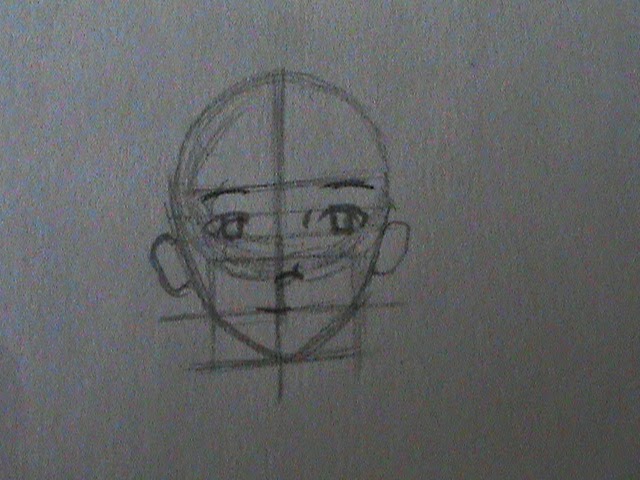
 Step one: Draw the head.
If you missed my last tutorial on drawing faces, here's a link: http://windowtothesoulcontests.blogspot.com/2014/03/how-draw-manga-face.html
 Step two: Add circles for the body.
A smaller one for the upper torso, and a larger one for the hips.
 Step three: Circles for legs and arms.
I only drew one circle for each arm, since the pose I'm drawing will have the character with her hands behind her back.
 Not a step: Proportions
I just drew a few brackets to give you an idea of how everything is proportioned, using the head as a comparison. Each bracket is one head long.
 Step four: Out line the torso and arms.
Take your time, and make sure that everything looks like the way it should be. 
 Step five: Outline the legs.
Again, take your time. Try to make the legs look symmetrical.
 Step six: Feet.
I have the toes pointing toward each other in this picture, but feel free to experiment and do them however you like.
 Step seven: Add clothing.
This may look like a complicated step, but it's not too hard. Just have fun and draw her clothes in your favorite style. A few wrinkles here and there will add a bit of realism to the drawing.
 Step eight: Outline the hair.
I've chosen to give my character sideswept bangs and a single braid over her shoulder. It's just the rough outline at this point--I'll make it more detailed later on.
 Bonus tutorial: Braids, step one
I erased all the lines under the braid, just so I can see to work.
 Bonus tutorial: Braids, step two
Don't try to make the exact shapes that I have drawn--they're not supposed to be perfect. Just make a few heart-ish-diamond-ish shapes, getting smaller as you go down the braid. A little ponytail on the end finishes up the outline.
 Bonus tutorial: Braids, step three
Add a few lines for the strand of hair every here and there, making sure they're going in the right direction for the braid. Voila! Done.
 Step nine: Darken your lines.
Make sure not to darken the guidelines your drew early on--you want to be able to erase those in the next step.
 Step eight: Erase guidelines.
If you drew your guidelines lightly enough, and your outlines dark enough, you'll be able to erase the guidelines easily and not have to stress over accidentally erasing a line that you want to keep. Even if you do erase one, it'll be dark enough that the mark will still be on the paper, and you can go back over it.
 Step nine: Finishing touches!
Sign, date, and add extra lines in the hair and clothing. Ta-da! You're all done.

A few quick tips for you:

In this tutorial, I had my character's feet pointing toward each other. I think that makes her look cute, and conveys an air of innocence. 
If you so choose, you can spread the legs farther apart, making your character seem more determined.

I've also got a nice little reference sheet of different poses for you. Move around an arm or leg by changing to location of a circle, and make an entirely new pose!
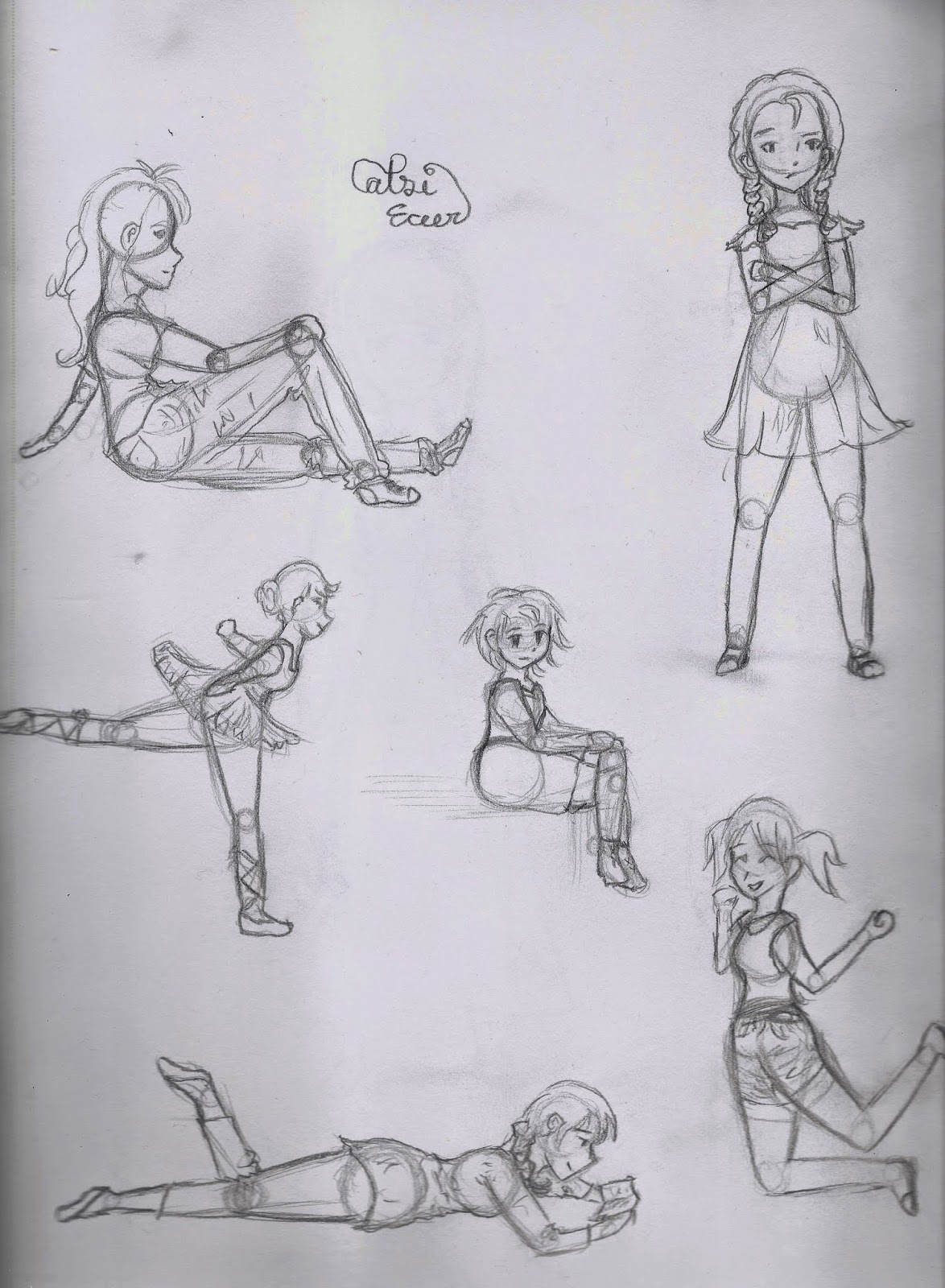
(I've left the guidelines unerased, so you can see the circles underneath the clothing.)

Well, I guess that's it. Hope you all had fun! If you have any questions, just post in the comments.
Also, I'd love to see how your drawing turned out! Feel free to email it to us, at windowtothesoulcontests[at]gmail.com, or if you posted it on your blog, drop us a link in the comments.

We have an art contest going on right now. You can view the guidelines here: http://windowtothesoulcontests.blogspot.com/2014/05/mother-art-contest.html


Saturday, May 3, 2014

Good Writers Drop Nukes--Guest post by Logan Judy

Guest post by Logan Judy

Good Writers Drop Nukes
I’ve long been obsessed with what makes a writer a great writer.  My interests in fiction are very diverse, stretching from massive classics like Les Miserables and Dante’s Divine Comedy to modern works like the Percy Jackson series and Neal Shusterman’s Unwind Dystology.  I’ve also read some books I despised.  So I kept asking, what separates these guys from the rest of the crowd?
There are many things that separate them, but I’ll tell you one that is very important, and fairly easy to grasp: Good writers drop unexpected, fat, whopping, H-bombs on their readers.  
Recently I was talking with a friend who is currently reading my novel Finding Sage.  He was referring to an event that happens about half-way through the book, and told me “At that point, I knew that everyone except for Silas (the main protagonist) was fair game.”  
That wasn’t intentional.  When I wrote that into the plot, I hadn’t sat down and decided I was going to make my story unpredictable by that plot element, but the effect was still there.  I had stumbled onto a gold mine.  Now I use that as a hard and fast rule for every novel.  Drop nukes.
Take for example J.K. Rowling (if you haven’t read the Harry Potter books, this is a huge spoiler, so you might want to skip this paragraph).  When I picked up Harry Potter and the Deathly Hallows (which just happens to be my favorite in the series), I had no idea what was going to happen to Harry.  For all I knew, he could live, he could die, or he could become possessed by dark magic and turn evil before killing himself.  I had no idea.  Why?  Dumbledore.  Most fans may never have said it aloud, but Harry Potter fans assumed that Dumbledore was off limits.  She’d never kill him, right?  He’s the supreme leader!  The guy’s practically a god!  There’s no way he could die!  Then she killed him.  That was a nuke if there ever was one.  The result?  We all had no idea what to expect.
That’s the power of dropping a nuke.  Every reader starts a story with the assumption that all of the main protagonists will live and the villains will all die or be permanently subdued in some fashion.  When you tear that assumption to shreds, you set a precedent.  By killing an important character, for example, the reader is never sure that any of his or her favorite characters are safe, even if you don’t kill a single character for the rest of the series!  A good guy is shown to be a traitor, and all of a sudden every suspicion on the part of that paranoid worry wart is legitimized.  
There can be good books without nukes.  I’ll give you that.  But the ones we remember are the ones with nukes.  That’s why we remember the sixth Harry Potter book so well.  That’s why Christopher Nolan fans love The Prestige so much.  That’s why Star Wars is such a classic.  And that’s why so many predictable books get lost in the shuffle.
Good writers drop nukes.  So go into your writing spot and pull out your plot chemistry set.  For me that’s a crowded desk in a tiny excuse for a room that used to be a breakfast nook.  For you that might be the upstairs bedroom.  Or your parents’ basement.  Or that table at Starbucks that might as well have your name written on it.  Whatever it is, go there, and get to work.  
I look forward to the mushroom clouds.

You can connect with Logan Judy, the author of this post, through his Facebook:
https://www.facebook.com/loganjudyauthor
Or, his Twitter:
https://www.twitter.com/loganrjudy

Thursday, May 1, 2014

Mother Art Contest

Deadline extended to June 25th!

     As you can see from the title, this will be an art contest, about mothers. During May. How fitting. You can use any art style you like, but the subject must show something having to do with mothers. It doesn't have to be an actual mother, or even female, but some quality of motherhood must be included. Catsi and I will be judging, and we will be judging based on the look of the drawing, but more so, emotion. If the chibi drawing evokes more emotion than the gorgeous painting, the chibi drawing will win. (And lets face it, mothers are almost always accompanied by babies, and chibi drawings make great babies.)

     The prize is publicity. We will tweet the winner's links and (with their permission) image, as well as post them on Facebook. Well, here are the guidelines:

"Mother Art Contest" or some variation of that should be in the subject line. Basically, just be sure that it is obvious which contest you are submitting to.

You may include a short bio, no more than 150 words.

You may include links to your blog, Facebook page, Twitter profile, website, etc. These can either be in your bio or after it.

Your name or pseudonym should be in your bio or, if you do not have a bio, in the body of the email.

If you sign your works you should provide two versions, the original and one with your name blurred out.

If you do not want us to display your image, mention it in your submission email. Otherwise, we will show it on our website, in our newsletter, and possibly on Facebook and Twitter. If you would like it to be posted on our website and newsletter but not Facebook and Twitter, mention it in your email and we will respect your wishes. This does not disqualify you, nor will it affect your chances of winning.

Your submission should be in GIF, PNG, JPEG or PSD format. 3D art is accepted and encouraged, but it must be a flattened image in one of the above formats.

Your submission should not contain any nudity. This website is intended for adults and teenagers, and is, in fact, run by teenagers, so we would appreciate that you respect that.

All rights remain with the creator.

We assume that you have all rights, or permission from the other creators, and that you were an integral part of the creation of your submitted work. If there are multiple creators you may have multiple bios and connected links.

You may send in up to three images, preferably in one email. Previous and simultaneous submissions are welcome.

Send all submissions before midnight on June 22nd.

Send your submissions and any questions (which we are happy to answer) to windowtothesoulcontests[at]gmail.com


We have one other contest currently running, this one is prose, in fact it's a prose contest. If you're interested, click here.

Haiku Contest Winner

     I am proud to announce the winning poem of our haiku contest!


The grey morning fog
Rakes its fingers on the ground
Trying to hold on


     Some of you may recognize this as the poem posted in the comments on my "How to Write a Haiku" post, and indeed, it is. Congratulations to our winner, Rosemary Mucklestone. Rosey is a historical fiction and sci-fi writer, and you can find her prose works here.
     Everyone congratulate our winner! Good luck for next time, everyone! Our next contest is an art one, the theme being "Mothers", and we have a prose one going on right now (you can find that one here). If you're really more of a poet, sign up for our newsletter, it's up on the right here, and we'll email you June first with a new poetry contest.

Saturday, April 26, 2014

Rules and Kites

Post by Elisabeth TenBrink Kelley, co-founder

     I very recently moved from Mexico to the state of Washington. Being who I am, I hated it. I hate change, it's simply who I am. But, with the change came new things, new experiences, and the new experiences brought new views, understanding, and inspiration. This week I went kite flying with my grandma, and I realized how writing is very much like flying, and then I realized that all the arts are like it. Heck, maybe every skill is.

     When flying a kite, you have to wait for a good wind. You can, of course, run to make your own wind, but once you run out of room to run, your kite will fall down again. Running can make a poor winds enough to get up to the higher winds, but in and of itself is not enough. To me, the wind represents luck. But to fly a kite well, you need to understand when to let out string, and when not to. If you let out too much string, your kite will fall, but if you don't let out any, it will stay close to the ground, subject to the fickle near-ground winds that constantly die, pick up, and die again.
     Your hand, your holding of the string, is rules. All the different writing/drawing/painting/poetry rules that exist are represented by your hand. When you hold it down, the kite catches the wind and soars higher. Once it has enough height, you let out more string, the equivalent of trying some things that aren't in the rulebook, and your potential increases.  As you get higher (more skilled), you can let out more string (ignore the rules more).
     The greatest writers ignore the rules, because the important things are natural, and the things that can be bent or broken, they can have the skill to do without. Everyone needs to follow the rules at the beginning, to learn, and as they progress, they can do their own thing more. They are at the point where they would fly highest if they just let go of the kite and let it soar on its own. Of course, in real life we never do that because we like to keep our kites.

     I am an amateur artist when it comes to drawing. I make some pretty good stick figures, and a single, unpaired eye (I can never make them match) but that's really all. Remember when Josie posted that awesome art tutorial? It made me feel empowered, like I could finally draw something well, but instead I left the instructions and ended up failing, because I'm not at that point in my drawing skills. My kite is crashing into the trees because I give it too much string.

     What about you? Are you giving yourself too much string? Too little?

Elisabeth TenBrink Kelley is an aspiring author and poet. To learn more about her, see our About Us page. You can follow her on Twitter here: @ElisabethGTK.

 We have a synopsis contest currently open, which you can find here. Our haiku contest is past the deadline, and we will announce the winner on the first of May both here and in our newsletter, which you can sign up to here.

Saturday, April 19, 2014

What makes a poem? (Catsi's Version)

The difference between prose and poetry is pretty obvious when you’re reading it. It becomes less so when you try to explain it.

“Well, poems rhyme,” says a boy that I know. (He’s not a poetry fan.) Sure, some poems rhyme. But many others don’t. Rhythm? Yes, most poems have a set rhythm. But is that really what a poem is? A rhythm?

I think it’s safe to say that the emotion is different in a book and in a poem. A novel is meant to produce emotion. A poem pretty much is emotion.

The best poems that I’ve written have come from pure emotion. When I’m just so happy, or so lonely, or so bitter, that there’s nothing left to do but put the feeling into a poem. They don’t normally rhyme, and, though I try to stick to a rhythm, it doesn’t always go well.

I think that’s how you write poetry. You put emotion into words.

Of course, that’s a lot easier said than done. Often times when I’m writing a poem, I spend more time chewing on my pencil, or flipping through a thesaurus, or banging my head against the keyboard, than I do actually writing. And, as is the case with all of my writing, I use the backspace key more than anything else.

But don’t worry about stuff like syllable count or rhyming or rhythm right off the bat. When you first sit down to write a poem, just get out your emotion. Don’t spend forever looking for the perfect word for that sentence. Just write.

I could try to tell you about all the different kinds of poems, and how to write each one. I’m not sure that would go too well, though, because the kinds of poems that I know about are Poems That Rhyme and Poems That Don’t Rhyme. (Okay, yeah, I know more than that. I know about haiku and limericks because Elisabeth posted about them.)

Most of the poems that I write are free verse. Meaning, I don’t worry about anything except the emotion going into the poem. They usually have a bit of rhythm to them, but they rarely rhyme. But there’s something about well-written free verse poems that is so beautiful, so emotional. I think it’s that there really is nothing else to the poem but emotion. It’s not the words that are in the spotlight—it’s what the author was feeling while writing it.

There are lots of different emotions you can play in a poem. Some poems are just meant to be funny, to make you laugh out loud. Some are angry poems, and you can actually feel how upset the writer was. And then there are the sad poems. The ones that actually make you tear up.

Be creative, and have fun. Poetry isn’t something to stress about. Your first poem won’t be perfect. Mine wasn’t. Mine still aren’t. But with practice, they’ll get better. And you might find that poetry is the best way for you to get out your emotions.


It’s a funny feeling
knowing that you’re losing
everything

Everything
I tried so hard to hold on to
is gone

I’ve lost it all
but somehow
I think I’ve
found
a new kind of
everything

Found, by Catsi Eceer

Any questions or comments? Just want to chat about poetry? Say something in the comments! I’d love to hear from you. :) (<-- Look, a smiley face. I am a human, see?)

Saturday, April 12, 2014

6 Ways to Spice up that Boring Chapter

I'm sure all of us writers have experienced it before. We're writing along, exciting scenes, developed characters, deep plot, and then, BAM! We're stuck.

Actually, a better word would be, "Bleh," we're stuck.

There is nothing more frustrating for me then going from a scene I'd already planned out in my head that goes almost exactly as it's supposed to, and then hitting that one scene where I still needed to do a bit of work. Or, you know, two or three scenes like that. In a row.

Boring scenes. I hate them. I've figured out that I can sometimes skip them, and it won't even make a difference to the story. (In fact, some of my exciting scenes are like that too...) However, lots of the time I can't skip. They're necessary to the story. Without it, there will be something not quite right about the transition between the two chapters. But the scene is just plain boring.

So how do you spice it up? How do you get your reader's interest (and, more importantly, your own interest) back into the story?

Here are a few tips that I came up with:

Bring in some necessary details. What are some things that your reader is going to need to know by the climax that you can put in this chapter?

Add some conflict. I don't mean that you need to have your main character fight someone. It doesn't need to be literal. Just make their will clash against someone else's. What do they want in this chapter? Who or what could be against them getting it?

Make them fail. What is the main character trying to accomplish in this chapter? How could they fail?

Introduce a plot twist. What would be an unexpected event that could happen in this chapter?

Leave it out. Is this scene really necessary to the story? Would the story suffer if you left it out?

Think about it from a different character's point of view. What do other characters think about the events of this scene? How could they affect what happens?

And when all else fails, just skip the scene giving you trouble and write something else (such as a blog post on what to do with boring chapters...). Taking a break from the scene will give your brain time to subconsciously figure out the problem and come up with a solution.

What do you do when you get stuck on a scene? Let us know in the comments section! I'd love to hear from you. :)