Showing posts with label educational. Show all posts

Saturday, June 27, 2015

Basics of Traditional Publishing

Post by Elisabeth TenBrink Kelley, co-founder

     Last time I talked about self-publishing, which is considerably easier to carry out. This time I will talk about traditional publishing, which, though easier to wrap your head around, is much harder to accomplish. Either way, success is very difficult, but traditional publishing gives higher chances, which is why it requires more effort to even begin.

     A traditional publisher is one that accepts manuscripts from authors (sometimes through agents or by request), works with them to improve the manuscript, provides a cover, marketing, printing, and distribution, and then pays the author royalties, and occasionally an advance.
     Getting accepted by a publisher is a rather complicated process, and you can expect it to take several years (or decades, if you are unlucky) and dozens, hundreds, or even thousands of rejections. Here are some tips to improve your chances and shorten the process.

Have a good product


     I mentioned this in the last one too, but it is very important. Don't send them the first book you write, and preferably not the second or the third, until you have written several other books as well. Rewrite your book several times. Send it to friends, maybe even an editor, preferably a developmental editor.
     Continue to work on your book as you submit it. A book can always be improved. This becomes especially important if you get something other than a form rejection letter. That is a good sign, it means that you are getting close.

Have a good cover letter


     Hardly an easy thing to accomplish, but this is your first impression. If your cover letter isn't good, your novel won't even get a glance. Keep your cover letter short and informative. Do not use a form letter. You will probably want to use the same synopsis each time, perhaps tweaked for the particular publisher, but the rest of it needs to be made completely new for each one. Use the editor's name, say why you think they are a good fit, name some of the novels that they have published recently that have similarities (but aren't too close!) to your book.

Choose the right publisher


      Please, please, please do your research. There are lots of companies that look great that you should never go near. If they ask you to pay them (aside from, maybe, a reading fee) then they aren't good. That means that they don't have enough confidence in your book to take a risk.
     In the part about cover letters I said to include why you think that your book is a good match for them. Well, you should actually believe that you are a good fit for them. Otherwise, what is the point of submitting to them?

Get an agent


     This is optional. Agents are kind of odd, because they make getting published easier, yet to get an agent requires the same process, just to the agent's company, rather than the publisher's. However, the truly important thing that agents do, is they negotiate the terms of publication. They will get you a better deal by far than you can get yourself. In fact, if you decide to forgo an agent during the hunt for a publisher, once a publisher accepts you, go find an agent. They will jump at the chance to represent an author whose book is already accepted.

Build an author platform


    An author platform is essentially your following. Building a following while you still don't have anything published can be difficult. One of the most commonly recommended methods is to make a blog, though I would say that the most necessary is a website. A website won't really build you a platform, but it is a place for people to look you up at where you can put your contact information.
     I would recommend also using one or two social media websites, like Pinterest, Twitter, or Tumblr. Experiment with different ones and find which you will be able to keep doing. Pinterest tends to be a favorite with authors, and it is the easiest one to advertise with that won't annoy people, but is also the least direct. Don't go overboard with building your author platform, but don't neglect it, either. This is one of the things publishers look at when considering a book.


     Traditional publishing is a hard route, and there is less creative control, however, you have much more assurance that you will end up with a fantastic product, and once a publisher accepts you, your chances of success skyrocket. Don't think that once you're accepted that you can quit your day job, though. Writing for a living is a hard job, no matter what way you go. The publisher will take most of the profits in exchange for the work and money they put into it, so you will need to either because a huge bestseller, or, the more likely, publish a lot of books.


Elisabeth TenBrink Kelley is an aspiring author and poet. To learn more about her, see our About Us page. You can follow her on Twitter here: @ElisabethGTK and on Tumblr here: http://dragonheartetk.tumblr.com/

Saturday, June 20, 2015

Self-Publishing Basics

Post by co-founder, Elisabeth TenBrink Kelley

     I asked some people if they had any questions about publishing, and the answer was "How do you publish?" So I'm going to cover self-publishing this week, and traditional publishing next week. I will also expand on certain points I will touch on at some point.


Have a Good Product


     Pretty obvious and basic, but something that people constantly complain about self-published books lacking. Your book is not good enough. When you have gone through several drafts, edited it, perhaps given it to some friends to read, it is not good enough. If you published this traditionally, at least one editor would work with you on it for at least one more draft, probably more, in order to make it a product that will hopefully sell. So, how do you make it a good product?


Do several rewrites

     An important beginning point, rewrite it several times, and leave space in between them. It is important to look at it with new, critical eyes and to do your best to make it the best book you can make it. It will be hard, it will hurt, but some things will have to go, and some things will have to be added. You will need to make major changes and minor changes. Write the first draft with that in mind.

Find beta readers

     This is very important. Get the feedback of several people. Friends an family will do, but make sure to stress that you need them to tell you the problems. Remind them that if they don't tell you now, it will end up in the finished book, which is hurting you rather than helping you. Listen to their feedback, respond well, consider it, then decide if you want to use it.
     Beta readers who are writers are very helpful as well. You can trade beta reading, as well as pay professional beta readers.

Send it to an editor

     Do NOT publish your book before sending it to an editor. First get over-all, character, plot, and logic editing. Make sure that the base book is good. Be willing to listen to your editor, they know what they are talking about. However, you do not have to do everything that they tell you to do. Next, get an editor to do proofreading. One of the most frequent problems with indie books is grammar and spelling mistakes.

Have a good cover

     Not exactly a part of having a good product, but you should have an eye-catching, fitting cover. You can usually tell the genre of a book at a glace, without the title. I could tell you one of those erotica "romance" books through frosted glass, and I don't even read them. You want your cover to make sense to your genre, but not be so close to others so as to look like a part of the mass.
     Also, don't copy popular books. The main reason that I never read Divergent was because, on top of the similar setting, the cover looked so close to The Hunger Games. Seriously, a bland, dark background with a circular symbol? A bit familiar.

Choose a Good Platform

     One of the most important factors for visibility and profitability is how and where you self-publish. There are two types of platforms, print and electronic, and two forms within them, hosted and self-hosted.


Print-on-demand

     POD is the easiest, though least profitable, method of selling print books. You find a company such as CreateSpace, upload your document and cover, set your price, and they take care of the rest. Once someone orders your book, they print a single copy of it and ship it. Because of the one-at-a-time printing method, they are more expensive to make, which is why it will be less profitable.  But still, you don't have to take care of it yourself.

En mass printing

     Another option is to pay a printing company to make a large number of your books (the more they print, the cheaper per book) and then sell and ship them yourself. This involves more effort (and storage space) but you will earn more money.

Mini publishing company

     The last printing option is to purchase your own printing equipment and do the whole process yourself. This has a huge start-up cost, but would eventually get you more money, if you sell enough books.

Hosted ebooks

     There are a variety of places that will host your ebook, from Amazon's KDP to Smashwords. These work pretty similarly to POD, in that you just upload everything, and the they sell your book, while taking a cut. The cut is generally smaller than with print books due to there being no printing costs, but the price of ebooks are usually cheaper too.

Self-sold ebooks

     You can make your own ebooks (as PDFs or mobile files) and sell them on your blog or website. This generally has less visibility than when they are hosted and is harder to do, but you get more money per book.

Market Your Book


     Marketing is one of the things that most authors hate doing, but it is extremely important.  There are infinite ways to market your books, so I'll just give some tips on how to go about it.


Begin marketing before your book is ready

     I used to think that I didn't want to market my books until they were released so that people could buy them immediately. However, marketing your book before it is out allows you to build up interest before the big day. Don't market too early, though, or people will forget about it.

Use free methods

     There are lots of ways to advertise your book for free, and many of them are very effective. Pinterest is a great one, if you already have it, as well as Tumblr, Twitter, etc. A blog or website is great too. (You should probably have at least a website, even if you don't pay much attention to it.) They are more natural ways of getting your book out there. People tend to ignore ads, knowing that they are ads, and thus not actually of interest to them.

Don't be obnoxious

     It is easy to fall into the trap of posting a bunch of "Buy my book!" tweets/blog posts/etc., but in the end this will just annoy people. Be nice, think of your customers, and keep promotional posts of any kind down to 50% or less.

Find the good paid services

     There are certain paid things that are completely worth it. Whether this is a book tour, an ad in a big magazine, or paying to get an awesome website, is dependent on your book, platform, and who is offering the service. Be careful with this, you don't want to go overboard, but do keep it in mind. A few good paid services can really help to launch your books.

Bonus tip: Paying for followers, likes, subscribers, etc. is never a good expense.


Elisabeth TenBrink Kelley is an aspiring author and poet. To learn more about her, see our About Us page. You can follow her on Twitter here: @ElisabethGTK and on Tumblr here: http://dragonheartetk.tumblr.com/

Saturday, May 30, 2015

5 Tips for Co-Authoring a Novel

Post by co-founder, Elisabeth TenBrink Kelley

     Co-authoring a novel is a very interesting experience for a writer (especially for an indie author) because the writing process is traditionally solo. I've personally found that it is a lot easier to keep motivation on a collective novel. They allow you to meld your skills with those of another author, making for a product neither of you could have created alone. Also, being exposed to another author's skills and viewpoints so thoroughly can teach you a lot. Here at a few things to keep in mind when partaking in such an adventure.

1. Don't Trample the Other Author

     It is very important that you allow the other author to express their thoughts, ideas, and sentiments. If you don't, why write a collective novel at all? Why not just write a normal novel? This is a co-operative endeavor, so listen to your partner. You will learn from them if you do, as well as end up with a superior product. Also, how do you think it would feel to be trampled? It wouldn't be pleasant, so respect your fellow writer and listen to them.

2. Don't Let the Other Author Trample You

     This works the other way around as well. Don't let yourself be trampled, as it will make the whole experience a nightmare. Make your voice heard, don't just be silent. Compromising is great, and important, but make sure that you are not the only one compromising. The next point ties in with this one.

3. Choose the Right Partner

     This may seem obvious, but you need to choose someone who can work well with you. If you are a hardcore sci-fi author and your partner does Amish romance, you aren't likely to get very far, unless you are somehow combining the two into something you both will like. But also temperaments are important. If you are a meek person, choosing someone who is more on the pushy side may be a mistake, unless you are sure that they can keep their shortcomings in mind. Also, the other way around. If you tend to be more pushy, either choose a person similar to you, or make a point to ask the other what you think.
     A good way to choose a partner you can work with is to each critique the others work first. This will allow you to understand them better (both from their writing and their critique) as well as build trust. And remember, opposites aren't always bad. If you tend to be character-based and your partner tends to be plot-based, your novel will likely be strong in both.

4. Make Sure Your Goals Align

     Writing a novel is a long process. Make sure that your co-author is committed to finishing the project, and also that you agree on just what the project should be. Many conflicts can arise later on in the process, such as late rough draft or even redrafting and editing, because of differing assumptions. Maybe you both agree on the plot, cast, and theme, but how a particular character thinks, or the meaning behind a certain event, might be completely different in your minds.

5. Be Ready for Compromise

     This may seem like a repeating chant, but it's really the most important point. You WILL have differing opinions on different aspects of your story. It is impossible to prevent that, because you can't talk over every single detail, and a lot of times there is no "better", just "preferred". In these cases, you will have to compromise. This may mean you give up your idea, they give up theirs, or you both give yours up and look for a completely new solution.  But it does mean that the novel will not turn out how you envisioned. This is true for any novel, but much more so with a collective novel. You need to be ready for this, and relinquish that expectation. It is a lot easier to deal with when you have prepared for it.


Elisabeth TenBrink Kelley is an aspiring author and poet. To learn more about her, see our About Us page. You can follow her on Twitter here: @ElisabethGTK.


We have a short story contest right now, where your submission must contain a dangling participle. See the guidelines here.

Saturday, May 2, 2015

3 Tips for Writing a Prologue That Works

Post by co-founder Catsi Eceer

Hi guys! I know it's been a while since I've posted anything on here, and I've missed you all a ton. But now I'm back (hopefully for a while this time), and I've got lots of post ideas for you.

Today I want to talk about prologues. I know a lot of people who are completely against them, and some who absolutely adore them. My views aren't on either extreme, but I'd like to explore the aspects of what makes a prologue work or fail in a novel.

So many people skip prologues, if they're boring. They might put up with a slow first chapter, but they won't stick around for the prologue if it's dull. Lots of people skip prologues without even glancing at them. (I once accidentally skipped a prologue because I didn't realize it was there... I don't think that was the prologue's fault, though.)

However, there are some very good prologues I can think of. Ones that definitely help the story, rather than detract from it. What makes those prologues work? I've come up with a few ideas.


  1. Make your prologue interesting.
    This one may seem like a no-brainer, but it goes a little deeper than you might think at first. There needs to be some kind of action, some kind of conflict, just as if it were a chapter on its own. Do not, and I repeat, do not spend the entire prologue rambling about the history of your fantasy world. If your reader really needs to know all of that, put it in the actual story. They won't stick around for the prologue.
  2. Make your prologue relevant to the story.
    Another seemingly no-brainer, that's often ignored in prologues. Make sure that what your telling us about in the prologue is actually important to the story. If you took the prologue out, how would it affect the rest of the novel? If it doesn't affect the story, chances are, it shouldn't be there at all.
    Maybe you need to write out the history of your country, or the details of an old war. That's fine--write it for yourself. But don't put it in the prologue.
  3. Give your reader someone to care about in the prologue too.
    If it's relevant, and it's interesting, that's great. But make sure we have a protagonist to follow in this scene, a main character of sorts. If we don't know who we're supposed to be paying attention to, we might not be paying attention at all.
    And this is where a tricky part of writing successful prologues comes in. If you manage to get the reader attached to the main character of the prologue, they're going to be disappointed when they get to the actual novel and find a completely different character waiting for them. So if it's at all possible, use the main character of the actual story as the prologue main character too.
Do you have a prologue? Does it match up to the 3 Tips I've come up with? Do you have another idea of what makes a good prologue? I'd love to hear about it! Let me know in the comments.

Saturday, April 25, 2015

How to Write a Villanelle Poem

By Elisabeth TenBrink Kelley

     Here's an interesting poem type. It uses a type of stanza we haven't talked about before: the tercet. A tercet is simply a stanza with three lines, but they are used so little that Spell Check thinks it isn't a word at all.
     A villanelle has five tercets and then a quatrain, totaling 19 lines. The rhyme scheme is ABA ABA ABA ABA ABA ABAA. So you basically have to accept the fact that you're going to be repeating words. Instead of one of my hastily-written example poems, we're going to use a poem old enough that we don't have to worry about copyright.


Do Not Go Gentle Into That Good Night
By Dylan Thomas


Do not go gentle into that good night,
Old age should burn and rave at close of day;
Rage, rage against the dying of the light.

Though wise men at their end know dark is right,
Because their words had forked no lightning they
Do not go gentle into that good night,

Good men, the last wave by, crying how bright
Their frail deeds might have danced in a green bay,
Rage, rage against the dying of the light.

Wild men who caught and sang the sun in flight,
And learn, too late, they grieved it on its way,
Do not go gentle into that good night,

Grave men, near death, who see with blinding sight
Blind eyes could blaze like meteors and be gay,
Rage, rage against the dying of the light.

And you, my father, there on the sad height,
Curse, bless, me now with your fierce tears, I pray.
Do not go gentle into that good night,
Rage, rage against the dying of the light.


     Well, I guess you could probably repeat words a little less than this one does. Anyway, because of the way the rhyme works, this is a very lyrical poetry form, and it sounds very traditional. Personally, I think it's really fun, and will likely attempt my own soon.
     Thank you for reading!


Elisabeth TenBrink Kelley is an aspiring author and poet. To learn more about her, see our About Us page. You can follow her on Twitter here: @ElisabethGTK.

Saturday, April 18, 2015

How to Write a Ballade

 Post by Elisabeth TenBrink Kelley, co-founder

     First of all, I'm teaching you how to write a ballade, not a ballad. A ballad has much fewer rules and is much more well-known, though they are both known for their use of refrains. Ballade is pronounced "baa (like the sound a sheep makes) laid". So, on to how to write one of these things.
     A ballade is make up of four stanzas. The first four are long, with seven, eight, or ten lines (but apparently never nine) and the last one is short, four or five lines. Each stanza ends with the same line, or refrain. Now, keep in mind that though the first three stanzas can be seven, eight, or ten lines long, they all must be the same length. Now for my example.


Hot Chocolate

I never had much care for coffee shops
My brother and I, we hated the smell
Of those ground dark beans everyone adores
Some people every day make their stops
At these legal addiction stores, and shell
Out money galore, at which I laugh, except
When sitting at Starbucks, with a cup of hot chocolate

It was a long time before I liked the idea
Of going into any coffee shop, despite
How much my elders loved these stores
Why chose a drink shop over a pizzeria?
Even into my teen years, I had a child's appetite
Which disliked anything of coffee, though I loved
Sitting at Starbucks, with a cup of hot chocolate

More recently I have found the tranquility
Of a coffee shop, is quite nice, though still
I am not so fond of the scent behind the doors
But in them I find there is an odd sincerity
Of musty darkness, and the people who fill
My cup, and so now a new place that I dream
Is sitting at Starbucks, with a cup of hot chocolate

It is another place where I know what to expect
A place to regroup when the world has shoved
And this place I now like is, it would seem,
Sitting at Starbucks, with a  cup of hot chocolate


     Okay, to be clear, you don't have to use the wacky rhyme scheme I used. (If you're confused, I used ABCACD(Ref)  EFCEFG(Ref) HICHIJ(Ref) DGJ(Ref)) (If you're even more confused now, I don't blame you.) Anyways, the only important part of the rhyme scheme was the refrain. Seriously, the rest of it can just not rhyme, as long as you've got the refrain. And normally, you wouldn't mess with the refrain like I did with the added "When" and "Is", but I sort of wrote myself into a corner. Honestly, that's why the rhyme scheme is so weird. I had planned on ABCABC(Ref) DEFDEF(Ref) GHIGHI(Ref), but I couldn't get the third and sixth lines to rhyme and still make sense with the refrain. There's a tip to be learned here. When your rhyme scheme fails: complicate!
     Anyway, I hope I have left you informed rather than confused, and once again, I hope to see the cool poetry you guys come up with.


Elisabeth TenBrink Kelley is an aspiring author and poet. To learn more about her, see our About Us page. You can follow her on Twitter here: @ElisabethGTK.

Sunday, March 22, 2015

How to Write a Pantoum

Post by Elisabeth TenBrink Kelley, co-founder

     A rare and interesting type of poetry is the pantoum. It is made up of a series of quatrains (four-line stanzas) with the second and fourth lines of each stanza being the first and third lines of the next. Sort of like poetry juggling. Because of the repetitive style, this style of poem is very good for themes of nostalgia, memories, and the like. Here's another one of my on-the-spot poems for an example:

I let out a sigh
I don't want to leave
My homeland behind
What can a child do?

I don't want to leave
Sadly, in the end
What can a child do
When the time has come?

Sadly, in the end
Nothing can be done
When the time has come
And I have left

Nothing can be done
I let out a sigh
For I have left
My homeland behind


     Obviously very rough, and my repeated lines aren't always exactly the same, but you get the idea. It has kind of a cool feel, huh? Obviously, though, you have to be careful with this one. Partly, this is because it is easy to make it boring. Partly it's because it's really easy to get yourself stuck when you're trying to get the second-to-last stanza to actually make a final stanza that makes some sort of sense.
     But doesn't this seem like the sort of poem that would be fun to make really long? And, once again, I've found another poem type that I'd like to do a contest with.


Elisabeth TenBrink Kelley is an aspiring author and poet. To learn more about her, see our About Us page. You can follow her on Twitter here: @ElisabethGTK.

Saturday, March 14, 2015

Building a Language Part 4: Words

Post by Elisabeth TenBrink Kelley, co-founder

     Yes, we've reached that part. The planning is finished. You have decided what sounds you will use for the words, the symbols that will represent them, and even how they will be arranged in a sentence. All that is left is creating the words themselves. So, is there any way more interesting than just going through the dictionary?
     Well, an automatic response might be "Try translating something!" But the problem with that, is that languages are never directly translatable. The Spanish phrase "Me encanta" may literally translate to "It enchants me", but the meaning is far closer to "I love it". Ironically, the people of Pompeii had no word for "volcano". Your language much have the same sort of things. It is not an extension of your language, it is an extension of the people who speak it.

     My advice would be to start with the things that are necessary for speech, such as pronouns, articles (the, a, an), conjunctions, etc. Once you are done with that, you can move on to the more interesting parts.
     A good place to go from there is the subjects that would commonly be discussed by these people. There are bound to be farmers, right? Start with some of those things. Is religion common? If so, explore the words that would commonly be used in that area. What terms do they use relating to war? What are things that merchants would commonly talk about? Hunters? Royalty? Children? What are common, every-day items and activities that everyone would know? Foods? Pet animals? Whatever they use for transportation? Keep searching for areas like these, and try considering them apart from your own world. Look purely at what these people see and live in, and what they think of those things.
     Another thing to consider, is descriptive words. Nouns and verbs are obviously important, but adverbs and adjectives, as well as how they are used, help define, or show, a culture. Like English, do they have many words that basically mean "great"? Or "very"? Do they have a lot of ones referring to color? Do they have very few? What words would they use to describe someone they were in love with? Someone they hated? Their home?

     After going through all of these several times, you will have both the basic framework, as well as plenty of verbs, nouns, and descriptive words. What do you do now? Obviously you won't have gotten everything. Well, I'd say now is the time to crack open a dictionary and see what words you have "missed". Keep track of which words the dictionary had that you didn't, and which ones you had that the dictionary didn't, and be proud of every word you have already made that they don't have.
     You now have a working language. It isn't done, you will probably never stop adding to it, but it works,  it is full, and you can now you can teach others it to others. Once you have reached this point, writing a novel must seem positively easy, right?


Elisabeth TenBrink Kelley is an aspiring author and poet. To learn more about her, see our About Us page. You can follow her on Twitter here: @ElisabethGTK.

We have a poetry contest open, which you can find here.

Saturday, February 28, 2015

Building a Language Part 2: Symbols

Post by Elisabeth TenBrink Kelley

     Last time we talked about selecting the sounds for your language, and this time I'll be showing you how to make letters for them. I've divided it into three steps: choosing a style, designing the letters, and assigning the letters.


     1. Style:

     First is choosing the style of your alphabet. For example, do you want letters with the level of complexity of a Chinese word? A Latin (what's used in English and Spanish) character? Greek? This would obviously affect the time it would take to write, so keep in mind the practicality of the nation, as well as who uses the written language. If only the rich, who have time anyway, can read, then it could be very complex. If everyone uses it, it will probably be simpler for convenience.
     Of course, just like English, there could be different versions, some more complex, some more simplified. A wonderful example would be the Forerunner language found in Halo. Though it wasn't actually invented, the books give fairly good descriptions. Cortana explains that they tend to embellish on their base symbols, making it look like they have way more letters than they really have. It is also show that the Forerunners had a 3-D version of their letters. Wouldn't that be cool, letter sculptures? But I can imagine that only aliens with the ability to construct worlds would have the leisure time to make such a complex writing system.
     Another part of style is the type of shapes and lines used. Would it be flowing, like Arabic? Geometric like Russian? A mix of simple shapes like Latin? This can change the feel of your language quite a lot, and helps to define the culture that uses it. For example, my language, New Orcish, is similar in style to English, but a bit more complicated, and with more flowing shapes.
     Another question to ask yourself is, how is the punctuation (if it exists) differ from the letters? Punctuation tends to be smaller, and in English it's mostly just small dots, and dots with tails. Is yours similar? Is it a part of the letter? Does it go directly under the letters? Etc. Also, do they have number symbols, or are their numbers always written out?

     2. Design:

     These last two can actually be switched around in a way, as you can make a letter specifically for a sound, or you can make all of the letters, and then assign them. Obviously these steps are a lot more straight-forward, as well. Basically, for this step, all that you do is implement the design elements you decided on in the last step. This maybe be harder than you expected, so don't worry if it takes a long time. Also, make lots of different letters. Don't erase the ones you make, just make more next to them. Take on base letter and make different versions, make lots of completely different ones too. This will help you to explore what you want better, as well as give you lots of options to chose from. Once you have enough, proceed to the next step.

     3. Assign:

     Now you just decide which symbol applies to which letter, and which punctuation mark, and which number. This is basically just personal preference, so I can't really instruct you here.


     One extra tip I have for you is a website called FontStruct. It allows you to build your own font, so you can just input your letters instead of the English letters, and then you'll be able to type in your language. And other people will be able to type in your language too! A wonderful thing to have when your books become bestsellers, huh?


Elisabeth TenBrink Kelley is an aspiring author and poet. To learn more about her, see our About Us page. You can follow her on Twitter here: @ElisabethGTK.

We have a poetry contest open, which you can find here.


For the next post in this series, click here.

Sunday, February 15, 2015

Some of the Most Annoying Mistakes in Romantic Subplots

Post by Elisabeth TenBrink Kelley, co-founder

     In honor of Valentine's Day, I decided to compile a list of things that people find most annoying in a romantic subplot. I've gathered these responses from the One Year Adventure Novel forum, so that would be why there are such odd names attached to them.


Chaellabird:

     The girl who doesn't think she's pretty, but in reality she's smoking hot.

     The guy who says, "You're not like the other girls."

     Love triangles. But a love octagon would be interesting.

     One person always needs to be rescued by the other.


King_Elessar

     When they don't belong.

     I hate it when a romantic sub-plot is not relevant to the characters outside of the actual sub-plot...like...it's existing for itself. Plenty of character dev. results from it...but only in relation to romance. In other words...it does nothing to actually do anything to the story...so there's no reason for it. Why should I care?

     Or, when it's the flip. When it becomes all you're supposed to care about. Like...I don't care about if you get the girl or not dude, go stop the Dark Lord...seriously.


Théoden:

     A disregard for what people would actually have time for in the story. Romance will probably not work when you're on a massive all-consuming mission to save humanity and the whole galaxy from a near-unstoppable force. If you have the time and energy to engage in romance, why on earth are you not focusing more on the mission instead?


Musicalfruitninja:

     Love triangles are demons kill it with fire please.

     I hate when a guy/girl chases someone who doesn't feel the same way for a long time and then suddenly they're like madly in love. That annoys me so much i can't even express it properly.

     Also it annoys me when people fall in love basically at first sight. a week, maybe even a month goes by and suddenly they will do anything for each other and can't keep their eyes off each other.


Cnemi:

     Physical expression always being portrayed as the epitome of a romantic relationship, no matter the situation.  This is perhaps more of a moral issue with me, but is that REALLY the only way you can show the recently-widowed Ally's relationship to Ally II (for a random example)? 

     The guy and girl who hate each other and can't stand each other, only to come to love each other desperately by the end of the story.  This annoys me so much, and I've developed a pretty good ability to call it, occasionally even at the INTRODUCTION of Character II.  It can be a good plotline, I suppose, but I've seen far too much of it.

     Turning the Ally into the Love in the second book because the opposite-gender friends are older now, so, of course, that's just how it must work.

     Romantic relationships = best possible kind between any two characters.  Even when they've been firmly established otherwise/ it's forced/ etc.

     Characters in a relationship who nonetheless communicate as well as if they spoke totally different languages, leading to all the conflict.


Parsleymusic:

     Characters that claim they 'need' the other person, and when they would literally let the entire world end just to save that person, and then they do it and it becomes an actual thing that happens in the plot. 

 SyllverGuardian:

     Number one problem: They're all about The Kiss. Okay, I'm a hopeless romantic and a sucker for cuteness, but love is about more than your first kiss. It's commitment and sacrifice, something that a lot of romance plots and subplots completely disregard. Tangled vs Cinderella, anyone? If you can convince me (by showing me) that these people will stick together through whatever is thrown at them, support and protect each other no matter what, than yes, sure, I'll believe that they're meant to be together. If all you can show me is them making googly eyes and mooning over each other, you can forget it.


     So, there you have it. What a variety of readers/authors think about common mistakes in romantic subplots. Hopefully your readers will be shipping your fictional Valentine's like crazy.
Stormy:

When either person in the romance has no definition outside the other. I.e., they're only there for the other one. They have no thoughts, ambitions, hopes, behaviors, dreams, etc. Ex: Girl is there so the guy has someone to save, but has no purpose. (Not that having to have the guy save her is bad, but it's a negative thing when that's literally all the girl is there for.) Basically the love interest doesn't even have a character outside "the love interest".


Elisabeth TenBrink Kelley is an aspiring author and poet. To learn more about her, see our About Us page. You can follow her on Twitter here: @ElisabethGTK.

We have an art contest open for submissions, see the guidelines here. We also have a poetry contest open, which you can find here. 

Saturday, February 7, 2015

3 Things You Can Learn About Villains from J. K. Rowling's Mistakes

Post by Elisabeth TenBrink Kelley, co-founder

      Hated Villains

     Fact is, you probably did hate Umbridge more than you hated Voldemort. Why? Because Umbridge was an awesome villain. She's so wonderfully hateable. It's kind of fun to hate her, and it's really fun to see her punished. However, doesn't this show a little problem? Why do we hate the lady who was mean, cruel, and unfair over the guy who probably murdered hundreds personally, and maybe thousands through his followers?
     One of the reasons, is because she's there. You watch her do these things, and you see the immediate emotional reactions of the characters. Voldemort, well, you only really hear about what he does. This makes it much easier to simply shrug aside his actions and jump onto the sympathy that Rowling presents.
     Possibly worse is the way that Umbridge acts and appears. The simper, the ridiculous clothes, the kittens, the little cough. These things makes everything she does even more infuriating.
     Remember when Harry found out that Umbridge was still employed by the Ministry of Magic? Yup, that's the other thing. She gets away with it for so long. And it's not like Al Capone who everyone knew was bad, because people still thought she was good. People like Fudge condoning her actions was adding insult to injury. But, this wasn't a bad thing, was it? It's a part of why we kept reading; we couldn't stop until we had seen her punished.

     Realistic Power for Villains

     Another sub-villain who has the "up-and-close" advantage is Draco Malfoy. However, there's a problem with him as well. Think of the things he does. He reschedules the Quidditch match. He makes Ron do all the preparing of his ingredients when he's "injured". He takes over the practicing period. And so on. But seriously, would he be able to do all this? I suppose all the stuff pertaining to Buckbeak he could accomplish, because that all relied on his father and Snape. Within Snape's classroom, he had free reign, and that makes sense. But how could he possibly reschedule a Quidditch match? While he may have been Snape's favorite, he wasn't Dumbledore's. This lack of realism takes away from the effect that the injustices should have.
     So, just as you shouldn't let your hero be overly powerful, you shouldn't let your villains be unreasonably powerful. Being evil does not give you perfect acting skills, unlimited knowledge, or a massive wallet. They can have these individually, but they have to have them because they gained it themselves (or inherited it, if you're talking about the wallet) rather than because it makes things harder for the hero.

     Descriptions of Villains

     What does Umbridge look like? A toad. If you've read the books, you understood that. If you only watched the movies, you're going "Huh?" And that's the problem. J. K. Rowling had a love of using animals, or other odd things, to describe people. As a result, when I read her books I find them to be full of talking toads, pugs, and piles of dirty rags. This is extremely annoying, but no matter how hard I try, it's pretty much impossible to erase that first impression from my head. And thus, Pansy Parkinson looks like a pug and Mundungus looks like a pile of dirty rags.
     This is especially problematic with Dung, because a pile of rags simply cannot fit the shape of a human, so I have trouble imagining him as something with even vaguely normal proportions. But is wasn't all bad. Describing Pettigrew as rat-like worked quite well for me. So, a word of caution, don't go over-board with the creative descriptions, though they can sometimes work well.


Elisabeth TenBrink Kelley is an aspiring author and poet. To learn more about her, see our About Us page. You can follow her on Twitter here: @ElisabethGTK.

We have an art contest open for submissions, see the guidelines here. We also have a poetry contest open, which you can find here.

Saturday, January 31, 2015

Practice Writing

Post by Elisabeth TenBrink Kelley, co-founder

     Authors don't like the idea of doing a work specifically for practice, especially a long one. I mean, if you're like me, and a rough draft takes you about a year, do you really want that to just be practice? Well, whether I wanted it to or not, that "novel", really a novella, was practice. After looking at it a year later, I no longer hate it, but I know that it was still practice. Everything we write is practice, really.
     This process is particularly important for beginning writers, because, let's face it, how do we know that anything we write is publishable? I'm sure mine isn't. And so, I plan to write several books for practice, focusing mostly on my weak points, and once I am writing at a publishable skill level, I will then turn my practice novels into "real" novels. So don't feel like you're doing an injustice to your brilliant idea by making it a practice novel. All that means is that you're going into it with a mindset to learn, and without the intention of publishing it immediately.
     Just because it was written for practice doesn't mean that you can't publish it later. For example, I'm currently trying to find a good idea for a practice novel meant to improve my plotting abilities because that is my weakest trait. But trust me, a few books from now, I'll come back to it and make it publishable.

     Why Practice?

     My three favorite authors are Tolkien, Christopher Paolini, and J. K. Rowling. Yeah, I know, going with the mainstream. Anyway, Tolkien is the only one of those three whose books don't have obvious jumps in quality. Eldest is a better book than Eragon. Brisingr is a far better book than Eldest. And Inheritance manages to be a better book yet. Similarly, Rowling made many rookie mistakes in her first books that made problems for the later ones. On the other hand, The Lord of the Rings as a series is fantastic. There's no real change in quality between the three, though some might argue that The Two Towers has the traditional mid-series slump.
     Why is this? Well, look at the way they published them. Rowling finished Harry Potter and the Sorcerer's/Philosopher's Stone and published it. She finished Harry Potter and the Chamber of Secrets, published that. And so on. Paolini did the same thing, but Tolkien worked on his series for years, writing and re-writing them as a series. He didn't publish The Fellowship of the Ring until the rest of the series was pretty much, or possibly completely, finished. In fact, Return of the King was published less than a year and a half after The Fellowship of the Ring, which may have been to give people a chance to read the earlier books.
     How did this help him? Well, putting aside the fact that he spent twelve years on the series, he also had the practice of writing all three, when he was re-writing the first one. He was able to learn from each book, and apply it, because the books were still in his hands, and changeable. For the same reason, I recommend that writers not publish a single book until they have completed at least three, and by completed, I don't mean the rough draft. That way, you can do the learning, become a good writer, and then fix up your early books so that they don't hurt your name and/or series.

     How to Practice?

     When writing a practice novel, what do you do? How can you maximize your learning? Well, first, remember that every book you write is a learning experience, but, when you are writing a novel specifically to learn, you should change things a little.

  1. Decide what you are trying to learn. It is very important to know what, specifically, you are trying to improve. For example, I am trying to improve my plotting skills, so I should choose something plot-heavy. This could mean a mystery or thriller, which are naturally plot-based, or simply doing my usual genre, but outlining and thinking of plot more. It could even mean writing a serial story with both episode-sized plots and overarching plots. If you're trying to improve character interaction and emotion, try a romance, or a book focusing on the main character learning a lesson.
  2. Choose something you care about. You may be here to learn, but you aren't going to learn much if you lose all motivation because you didn't like the story in the first place. It can be hard to find the balance between something that will help you and something you will enjoy writing, but it is usually better to err on the side of liking it. If in doubt, ask a fellow writer and see if they think it will challenge you enough.
  3. Research. "What?" you say, "Why do I have to research? What if I'm doing something completely speculative?" Well, you should still research. Not for your book, necessarily, but on what you are trying to improve. Find some tips about plot/characterization/description/whatever, and put them into action.
  4. Be willing to compromise. This is probably the hardest for me. Even if it might feel like you are breaking or crushing your idea a little, you need to focus on learning. This may mean lots of different things, such as following a very strict outline, or perhaps putting in things that feel like they don't belong. This is okay. It's a practice novel, and you will change it later. It may not feel right, but this is not your finished product anyway. Go through the process, learn what you came to learn, and fix it when you decide you are ready to write publishable material, and then you will give it its true form.
  5. WRITE! This is the most important part. Go and WRITE it! Don't stop part way through, don't put it off, write it. This is a practice novel, and you will learn from what you do, even if only subconsciously. That means that if you don't finish it, or never even start, you are building a habit, and that habit is extremely hard to break, trust me, I know from experience. So go and write your novel.


Elisabeth TenBrink Kelley is an aspiring author and poet. To learn more about her, see our About Us page. You can follow her on Twitter here: @ElisabethGTK.


We have an art contest open for submissions, see the guidelines here.

Saturday, January 24, 2015

How to Draw Hair, Catsi-Style

Post by Catsi Eceer, co-founder

Yes, you get to deal with my art skills again today. I haven't posted a tutorial in a good long while, so I figured I might as well put one together for you guys.

I will warn you ahead of time. My style has changed a bit since the last time I posted a tutorial, and I'm not sure if it qualifies as manga anymore. It's mostly just Catsi-style now.

On to today's topic: Hairstyles.

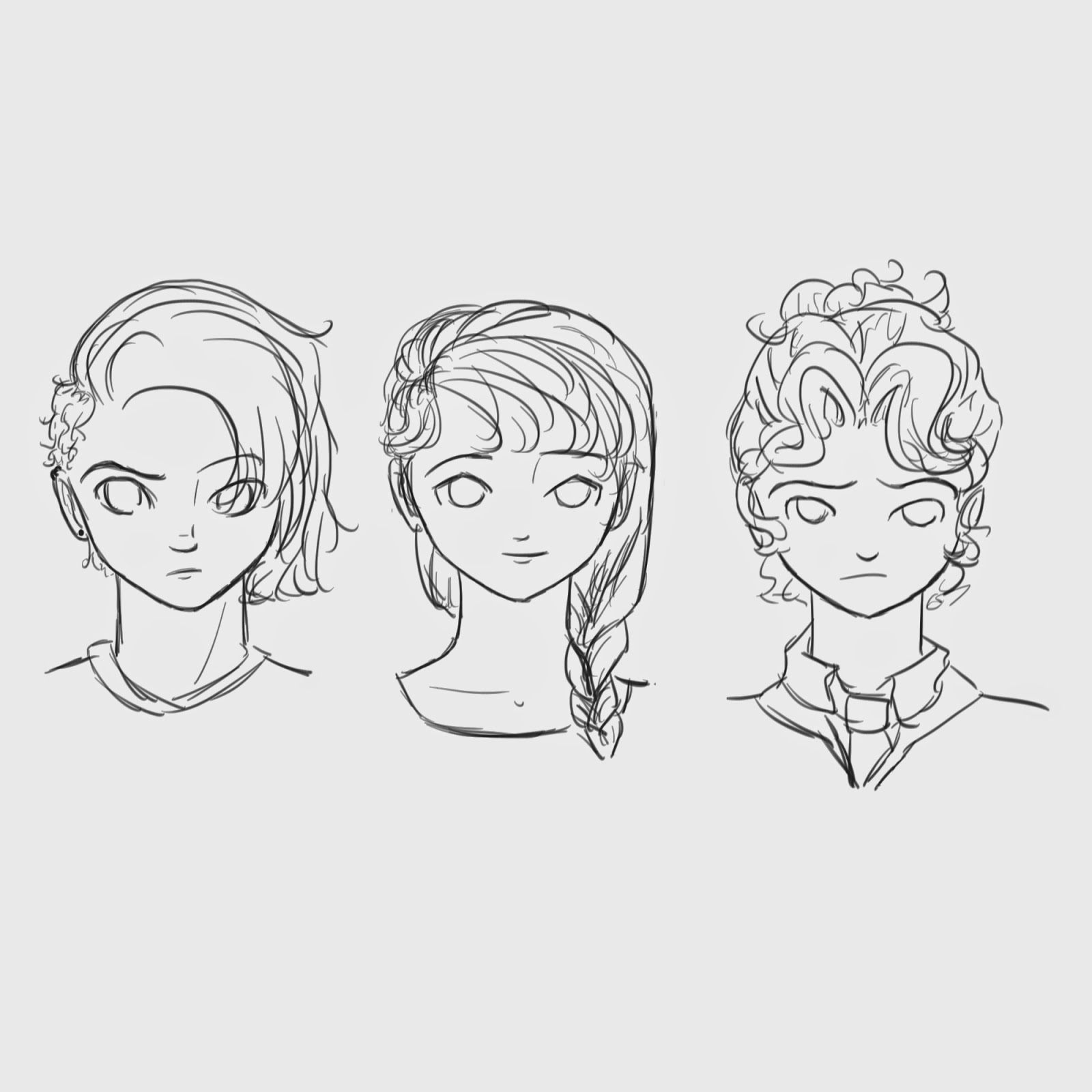
Or, to be more specific, Hairstyles that Define Character. "Character" being personality, in this instance. Something I tend to do when designing a character is just throw on the first hairstyle that comes to mind. While this does work sometimes, most of the time putting a bit of thought into how your character's hair looks will help whoever is looking at the drawing later know what personality that character has--just from a headshot!

Obviously, facial expression, pose, etc., are also helpful in conveying expression. But don't underestimate the power of a hairstyle.

(On a drawing. Forget hairstyles in real life--I'm too lazy busy to do anything with my hair. :P)

Step One - A face. Or three.
What is this? Three faces?

Yes. Lucky you gets three tutorials in one. I felt like further demonstrating how a hairstyle determines character, so I decided to draw three different examples.

Take your time with this step. If you're not confident in your blank-face drawing abilities, google a tutorial specifically on that. Or if you really, really want to, you can use the one I did last year on the subject.

Once you've got your basic face, and some rough guidelines to place your features later on, you can move on to the next step.


Step Two - Hairline.

Here is the first part of determining character. There are all sorts of different hairlines and parts. They can be straighter, pointed, even... Have fun with it! Put the part wherever you want. (Poppy's part is straight down the center, so it kind of merges with the guidelines.)

Annie's part has a line going perpendicular to the rest of it, because her hair will eventually be in a braid. The hair that's not a part of her bangs goes straight back, although it will still slightly follow the part line.

Step Three - Add front part of hair.

This step looks a little messy, because there are a lot of lines on a small drawing. Go ahead and zoom in a bit to get a better idea of where they're all coming from.

Basically, start at the part or hairlines, and start adding the hair in. Now is the time to choose whether the hair is straight, curly, or wavy; pick the one that shows your character's personality best. The bang style will also show personality.

(See how this is all coming together already? Rachael is obviously a more spunky, walk-to-my-own-beat person, Annie looks prim and proper, and Poppy just looks like she ran her fingers through her hair and called it a day.)

Step Four - Add the rest of the hair. I also gave them necks, because floating heads look really creepy at this point.

Now you get to decide where the rest of the hair is going. Is it long, short, or somewhere in the middle? Does she prefer it loose, or thrown back into a ponytail, or does she spend a lot of time putting it into some elaborate hairstyle? Or maybe she has someone to do it for her...

(If you have a royal character, this is the time to really have fun with the hairstyle. Delicate braids, curls and beads, and anything else that strikes your fancy!)

Step Five - Add details.
This step actually isn't hairstyle related. Just add character-specific details, facial features, and some clothing on the shoulders. (I won't go off on another spiel on clothing being equally important for defining character... Hopefully you already know that.)

I was also getting severely irritated by the fact that the faces were lopsided, so I cleaned that up in this picture as well.

Step Six - Clean up the lines and ink!
 Dark the lines you want to keep, and erase the rest. Or if you're drawing digitally, like I was, make a new layer and go over all the good lines. Delete the other layers, and voila! You have a finished drawing.

I'm not done coloring them yet, otherwise I'd post that as well. Maybe I'll save it for a coloring tutorial sometime...

Any questions? Comments? I'd love to hear from you! And I'd also love to see your art. Post a link to your blog in the comments, or if you'd rather, email me the picture at windowtothesoulcontests[at]gmail.com. I love seeing what you guys come up with! :)


We have an art contest open for submissions, see the guidelines here.

Sunday, January 18, 2015

How to Write a Spenserian Sonnet

Post by Elisabeth TenBrink Kelley, co-founder

     We've already shown how to write the two most common sonnets, so here's a slightly less known one. The Spenserian sonnet was invented by Edmund Spenseras, the author of The Faerie Queene, and has a rhyme pattern of ABAB BCBC CDCD EE. Each stanza tends to show or develop a single idea. Here's an example:


Sonnet LIV

Of this World's theatre in which we stay,
My love like the Spectator idly sits,
Beholding me, that all the pageants play,
Disguising diversely my troubled wits.

Sometimes I joy when glad occasion fits,
And mask in mirth like to a Comedy;
Soon after when my joy to sorrow flits,
I wail and make my woes a Tragedy.

Yet she, beholding me with constant eye,
Delights not in my mirth nor rues my smart;
But when I laugh, she mocks: and when I cry
She laughs and hardens evermore her heart.

What then can move her? If nor mirth nor moan,
She is no woman, but a senseless stone.


     Can you see the individual ideas in each stanza? The first sort of sets the scene as a part of the stage. The second talks about the emotions he feels, and the third talks about how his love reacts to it. (Raises the question, why does he love her?) The last one shows his conclusion.
     This poem has a cool progressive sound due to the rhyme. This poem type doesn't have a specific meter, but the lines are about the same length. Like many poems, you could change it by having the last line of each stanza much shorter or the last two lines much shorter, or longer.


Elisabeth TenBrink Kelley is an aspiring author and poet. To learn more about her, see our About Us page. You can follow her on Twitter here: @ElisabethGTK.


We have an art contest open for submissions, see the guidelines here.

Sunday, January 11, 2015

A Character Development Tip I Learned from Divergent

Post by Catsi Eceer, co-founder

Hello all, sorry I'm a day late. *winces* I spent the weekend at a friend's house to celebrate her birthday, and, of course, forgot to write a post beforehand.

I read Divergent by Veronica Roth last week, and watched the movie with my friend yesterday. While I must admit that I'm not unduly impressed by either, it did get me thinking. There were several very interesting aspects of the movie, and-- at least in the book--a good deal of character development. I felt that I actually knew the characters, though really, there wasn't a lot of "developing" that I could see. (Tris, to be honest, seemed rather flat for the majority of the story.)

I sat for a while and thought about it. What is it about these characters that make them feel more real than so many others in different stories?

Answer: We see their fears.

It's such a simple thing, really. What is your character afraid of? Four is afraid of four things: heights, small spaces, killing an innocent, and his father. Tris's list is a little more extensive, but to the same effect--we see what she's afraid of, and we see her.

After I'd finished ranting to my friend about how terribly the movie had ruined several of the characters, I pulled out a piece of paper and started making a few lists. (Because I love lists. I really do.) I grabbed a few of my nearest characters, and wrote down all of their fears.

(And I'm proud to say that one of them only has three fears. Take that, Four.)

Here's an exercise for all of you: Open up a Word document, or find a notebook and a pencil. Write your character's name at the top of the page, and then list everything they're afraid of. Every last thing. If you feel like going deeper, try to figure out why they're afraid of those things.

Was that hard? For an undeveloped character, it probably was. Even for a character you thought was developed before, it might have been a very difficult exercise. Fears are harder for us to give our characters. We might give them one or two random fears, like fear of spiders or claustrophobia, or maybe a deeper fear for those particularly messed up ones--fear of their abusive parent, or of being forced to hurt someone they love.

But you know what? Everyone's afraid of something.

Most everyone is afraid of several somethings, actually. I, for one, am afraid of scorpions, swimming in places I can't see the bottom of, heights, small spaces, being trapped, calling adults on the phone (yes, go ahead and laugh; I'm used to it), and losing one of my family members.

Does your character seem more real now that you know their fears? They should. Humans are fearful creatures; seeing someone with weaknesses similar to our own helps us bond with characters far faster than with a character who seems perfect.

So take your list, and figure out how to show those fears in your writing. Make your character fear, and make them human.

What are some of your character's fears? How do you show those fears in your writing?

Saturday, January 3, 2015

How to Write a Rondeau Poem

Post by Elisabeth TenBrink Kelley, co-founder

     Let me guess what you're thinking. "What the heck is a rondeau? Is that French?" Now let me answer. A rondeau is a kind of poem, nowadays with fifteen lines, containing only two rhymes, three of which are refrains. And yes, it's French.
     So, once again, what the heck is a rondeau? They're actually fairly complicated poems, but luckily, the meters are completely variable, so you can ignore that. They have three stanzas, the first being five, the second being four, and the last being six.
     Now, it only has two rhymes, meaning you're going to be using the same ending over and over again. Plus, each stanza has a refrain, which starts with the first line, and continuing with the last line of the other two. (I know, this is complicated.) By the way, a refrain is when the entire line is repeated. These poems also have a tendency to use the same words at the end of the lines, unlike most poems, which try to avoid that. Here's a visual aid:

1 A (Refrain)
2 A
3 B
4 B
5 A

6 A
7 A
8 B
9 A (Refrain)

10 A
11 A
12 B
13 B
14 A
15 A (Refrain)

     Make a bit more sense? Originally, the subjects were usually love, or nature, or some other light and happy thing, but now, as with most poetry types, it can be about anything. Here's one I found, for illustration.


Listen, Everyone!
By Jehan Valliant (14th century, I'm sure the copyright's gone)


Listen, everyone! I have lost my girl
For he who finds her, on my soul
Even though she is fair and kindly
I give her up heartily
Without raising a stink at all.

This girl knows her graces well
God knows, she loves and is loyal
For heaven’s sake, let him keep her secretly
Listen, everyone! I have lost my girl

Look after her well, this pearl
Let no one hurt or wound her
For by heaven, this pretty
Is sweetness itself to everybody
Woe is me! I cry to the world
Listen, everyone! I have lost my girl

Saturday, December 27, 2014

Writing an Acrostic Poem

Post by Elisabeth TenBrink Kelley, co-founder

     Acrostic poems can be really fun to write, but also kind of difficult. There is only one rule to writing acrostic poems, and that is that it must be an acrostic. An acrostic is usually a couple of words that spell something else, like FBI, except the letters combined actually mean something. With a poem, that could be the first letter of each line, first word of each line, or also the last of the lines. It can rhyme, have meter, all of that, but it isn't required.

     I'll try one of my own. It'll spell "writing".

Wonderful, like making a dream and living through it
Riddle-like in the making, so hard to see an hear
Inspiration comes slow at times, others like rushing rain
Thoughts fill my head, I worriedly begin to fear
Ideas, are they good enough? Why does this bring pain?
Never, though, will I give up, though it bring me tear
For the greatest joy I find, is when at my desk I sit


     This is extremely rough, I wrote it in like ten minutes. If the rhyme scheme seems odd, it's ABCBCBA. It would probably make more sense like this: odds go ABBA and evens go AAA. Anyway, though this is a rather badly-done poem with zero editing (edit your poems, guys, I know it's hard) it is an acrostic. Actually, only almost. You may notice that I forgot about the lettering on the last line, because I was focusing on the rhyme.
     This, of all poem types, probably needs most editing, because you need it to spell something, but it also needs to sound good, and you may have to worry about meter and rhyme scheme as well. Let's edit mine so that it actually spells "writing", rather than "writinf", and try to make it sound better.

Wonderful, like making a dream and living through it
Riddle-like in the making, so hard to see an hear
Inspiration comes slow at times, at others like rushing rain
Thoughts fill my head, I worriedly begin to fear
Ideas, are they good enough? Why does my dream bring pain?
Never, though, will I give up, though it bring me tear
Greatest joy I always find, when at my writing desk I sit

     I really didn't change much, which is why they always say to give your writing a break before trying to edit. Sometimes, months after writing them, sometimes more than a year, I'll come back to read my poems and end up editing them, even thought that wasn't my intention. Anyway, despite the fact that it's still considerably clunky, it is actually an acrostic now.
     I can't wait to see you guys' acrostic poems, I think they're so cool. We'll have to have an acrostic contest sometime.


Elisabeth TenBrink Kelley is an aspiring author and poet. To learn more about her, see our About Us page. You can follow her on Twitter here: @ElisabethGTK.

We have one prose contest open for short stories containing sacrifice, see the guidelines here.

Saturday, December 13, 2014

3 Ways You Should and Shouldn't End Your Novel

Post by Catsi Eceer, co-founder

     It's an important thing that is often overlooked by beginning writers--The ending. Everyone stresses out about writing a great opening, one that will hook your readers and won't let them go 'till the end.
     Openings are important, very important. Because without a good one, your readers won't even get to the end. But the question is, are they going to like the ending? Or are they going to be thinking, "Seriously? I just spent the last hour/day/week/however-long-it-takes-for-me-to-read-a-novel for that?"
     Here's the deal. When you have a bad ending, no matter how well written the book is, no matter how well developed your characters are, no matter how hooking your opening is, your reader is always going to look back on the book and say, "I didn't really like it."

     We're going to go over some ways you should and shouldn't end your novel. I was going to use some examples, except then I realized that it would kind of spoil the story for you if you hadn't read it yet. So, you'll just have to think of your own examples.

     Ways you shouldn't end your story:
  1. Deus ex machina. (It's pronounced day-us ex mah-kin-uh. Yeah. I didn't get it right the first time either.) This is a Latin term literally translated "god out of the machine." In modern literary circles, it means you as the author helping your hero out in the climactic scene. It's when your hero is about to be killed by the villain, when hooray! the sheriff comes and shoots the villain. The end, throw a party, marry Susie. In your novel, your hero must cause the end of your story. If there is some interruption, then it must be because of something s/he did earlier on in the story.
  2. Ending? What ending? This would be when you meander the story off into nothingness. Don't do that. We need a climax, the moment when all the conflict you've been building up finally gets resolved in one, big clash. Not just kinda unraveling until there's no story left anymore.
  3. Destroy the conflict! Basically, don't put a big reveal in the end that erases all the conflict you had in the rest of the story. (I read a book that did that, once. After reading the ending, you looked back at all the other story events and went, "Well. That really had no point after all.") While it's not horrible while you're reading the story, it's no fun to re-read, and leaves your reader with a sort of unsatisfied feeling.

     Ways you should end your story:
  1. Expected result, unexpected action. It's what we wanted to happen all along, but how on earth did they do it like that???
  2. Bigger and better. Make your climax even more exciting than you had built up for.
  3. Conclusive. It should fully wrap up the story. Don't leave some subplot unresolved, unless you're planning to write a second book. It'll just annoy your readers.

     What are some of your favorite ways to end stories? Any book ending that you really like or dislike? (Don't spoil the ending!)


Catsi Eceer is an aspiring author of fantasy and dystopian novels. To learn more about her, visit our "About Us" page.

Saturday, November 29, 2014

7 Things to Do Before You Give Up on Your Novel

Post by Catsi Eceer, co-founder

     I bet we've all been there at some point--your novel is just too boring/cliche/unbelievable/plotless/whatever that you feel there's no point in writing it any more.

     You loved this story at some point. It was a shiny plot bunny then, and you could just picture it on the shelf at the bookstore.

     But now it's lost all its charm, and you dread opening up the document. In fact, most days, you don't open it up at all.

     What do you do? Do you give up on the story, and start something new? Do you take a break? Do you force yourself to keep writing, even though you hate it?

     I think the answer is different for each writer. Sometimes you're really just burnt out writing-wise, and taking a few days off will clear up any problems. Or maybe you've taken off for too long, and you're having trouble getting back into the routine.

     But sometimes, the answer might really be that the story just isn't worth continuing.

     Now, before you enthusiastically pump my hand and thank me for giving you permission to ditch your story, there's a few qualifiers. You need to get through the list I have below, and you need to think each item through before moving on.


  1. Are you really sure your story is boring? Or is there just another "better" story that you want to write?

    I won't pretend that I've never had this happen to me. Plenty of times, I'll be about halfway through a rough draft, when I'll get a new story idea--one I'm sure is far better than this story will ever be.

    Sometimes, that really is the case. If you started this story spur of the moment, maybe there's just not a lot of good plot to keep the story going. It might really be best to drop this story and work on something else. But be careful--if you start writing that new story idea right away, what's going to keep it from doing the same thing halfway through?

    Just make sure to identify the difference between a good story idea, and a "shiny plot bunny." Plot bunnies are not reliable, shiny or otherwise. Develop, develop, develop, until you've gotten down to the core of the story. If it's still worth writing, go for it.

  2. Have you taken a break from the story?

    Try taking a break, if you're stuck. Spend the day with your family, or go somewhere with your friends. Watch a movie. Go for a walk. Do something away from your computer, laptop, or notebook.

    If you're just stuck on a story problem that needs to be solved before you can keep going--a very crippling issue; I know this from experience--chances are, just ignoring it for a few days will actually help. Your subconscious will be at work solving the problem while you get a break from your story.

  3. Have you gone back to writing after the break?

    I'm serious. After you're done with your break, sit down and write. Don't just say, "Okay, I've gone for three days without writing this story and I still don't feel like writing it. Goodbye, story!" Of course you're not going to want to write. Imaginations are lazy. When you go for an extended period of time without using it, it's going to be tricky getting back into the swing of writing.

    Do it anyway. After your break, spend a few more days writing. If you're still having problems with your writing after a week, maybe it is time to think about moving on.

  4. Identify what your story is really about. Are you still writing that?

    I've had this happen to me very often. I get so caught up in the words, the actions, the scenes, that I forget what the story is about. I have to take a step back, take a deep breath, and remember what I'm writing.

    What is your story goal? What does your main character want? What about that unnamable feeling you get when you think about your climax? Are you still writing that?

  5. Is it really a bad story, or do you just have Chapter Seven Syndrome?

    Chapter Seven Syndrome is my word for "I'm about two-thirds of the way through the story and I'm very sure that this is the worst thing I've ever written." It's not usually at chapter seven for most people, but when I started writing using a twelve-chapter outline, chapter seven was always where I lost my enthusiasm.

    If this is where you're at, take heart--it's a passing phase. Take a day off today, and start writing again tomorrow. Write as much as you can, even if it's awful. Eventually you'll get to a scene you've been wanting to write, and hopefully you'll start enjoying it again.

  6. Remember the enthusiasm you had for this story when you started. Is there any of that passion still left inside of you?

    I've found that writing a little note of encouragement to your future self when you start writing a story is very helpful. Take all of your enthusiasm and passion and love for your story, and write a few paragraphs about how amazing this story is. Go ahead and make it all flattery. Just make it sincere. If you have a good writer friend, ask them to write a little bit of something too. Then hide it all away somewhere, and don't look at it again until you're completely stuck and hating the story.

    Can you blow on that ember and relight the fire you had for this story?

  7. Are you really willing to give up?

    It sounds kind of harsh when I say it like that, but it's the truth. By giving up on your novel, you're doing just that--giving up. Are you ready to admit defeat?

     If you've gotten this far, and nothing is getting your interest back in your story, maybe it is time to start something new. Something you're truly passionate about, and something you'll see all the way through to completion.

     Just make sure you won't burn out halfway through again. Develop, develop, develop. Make sure this is a story you truly love. Make it something you'd want to read, and read again. Daydream about seeing it on a bookshelf, on Amazon.com, on a random review blog, read by somebody you've never met and probably will never meet. Imagine what the cover will look like, and the movie that will be made from it.

     Go ahead and dream. That's how we write, isn't it?


Catsi Eceer is an aspiring author of fantasy and dystopian novels. To learn more about her, visit our "About Us" page.

We have currently have a holiday poetry contest open, which you can find here.

Saturday, November 15, 2014

How to Write Free-Verse Poems

Post by Catsi Eceer, co-founder

     I was looking through the poetry posts earlier, and realized that we'd never done a post on free verse poems. Seeing as I write free verse almost exclusively, I thought I'd step up to the plate and scribble something down.

     Here I am twenty minutes later, still staring at a blank screen.


     The funny thing about free verse poetry is that, well, they're free verse. There's no specific rhythm or meter. They don't need to rhyme. They don't really need to do anything, except convey an emotion. There are no rules to them. Which makes it rather difficult for me to write about them.

     A free verse poem is basically a bunch of words. But somehow, the words need to convey the emotion the writer means them to convey.

     Ack. I'm explaining this miserably.

     Okay, I'll use a poem of mine as an example. I wrote this one a while ago, but I kinda like it. 

Step one: Find some inspiration.

     I was helping out in children's church one Sunday, and there was something about hearing each of the kids pray in turn while my sister played softly on her guitar that just made me want to capture that moment in a poem. It was the kind of bitter-sweet feeling that makes you want to cry when there's really no reason to.

     You can tell a story with your words, or capture a moment in time, or carry an emotion. How you choose to write it is up to you.

Step two: Choose your words. And choose them carefully.

     When you're writing free verse, a large vocabulary is your friend. Being able to choose just the right word is very important to the quality of the poem. Because most free verse poems are quite short, each word counts.

Step three: Just write.

     After that, just let the words spill out. There's no "right way" to do this. I think everyone writes a little differently. Some people might write all of the poem at once, then go through and edit. I tend to edit as I write, meaning I'll go back and fix up each line as I put it down. Do whatever works for you.

Step four: Fix it up.

     Try reading your poem out loud. Even though it doesn't have a set rhythm, the words should still flow. Make sure all of the lines run smoothly into one another, and the stanzas into one another.

     That's pretty much it. Four easy steps to writing a free verse poem.

     Since I promised you an example, here's mine:

Amen

Head bowed, eyes closed
A dozen hands-folded kids
The whisper of “Amen”
And the soft strum of the guitar


“Dear God, please help Mommy and Daddy;”
The little girl across from me prays,
eyes squeezed shut tight;
“Make our family happy again.”


“We love you, God:”
The last chorus of Amen
And I look into her eyes
She knows God will make it happen


I want faith like that
so even when it’s tough
I can keep praying

Any questions? Got a poem you want to share? Let me know in the comments!


Catsi Eceer is an aspiring author of fantasy and dystopian novels. To learn more about her, visit our "About Us" page.


We have two current contests, one is a holiday poetry contest, which you can find here. The other is an autumn contest for poetry, prose, and art, but the deadline is just days away! See the guidelines here.