Post by Catsi Eceer, co-founder
We've all heard the phrase "Write what you know." It's a bit of a controversial topic in writing circles. I agree with it to an extent--writing something you know about is definitely easier than writing something you've never experienced.
But what if it's something you want to experience?
That's a tricky phrase. I deleted it a few times before I decided that it's what I really mean. Because, really, who wants to experience Nazi Germany? Or losing both of your parents? Or being governed by a cruel, dystopian government?
(If you're like me, you might almost be able to risk it, just for the adventure of the story.)
As always, I'm focusing a little more on the characters-and-emotions side of the coin with this post. Because, really, isn't the difference between a good book and an okay book how it made you feel?
Even on this side of the phrase, it's a little tricky. We don't want to feel heartbreak, or grief, or betrayal, or go through all of the problems you put your poor main character through. (Or do we? There's a reason we read, after all...)
What we do want to feel, though, is the joy, the strength, the unnameable-feeling when the hero wins. When she survives despite the odds. When the theme is proved true after all.
We want the hope of knowing that, even though life is dark and times are hard, we can still win.
Sometimes, we forget about that. I know I do. I get lost inside my cynical, pessimistic mind, and I lose sight of hope, lose sight of joy. I'm so caught up in my own problems that I don't see the way through them.
This is where my writing comes in for me. When my main character (who, oddly enough, tends to reflect myself at the time of writing) makes it to the end of the story and finally figures out who he is and why he's been chosen, and then decides that it's been worth it all along, I decide that it's worth it for me, too.
Life is hard. But I'll get through it.
I write a combination of what I know--the problems--and what I need to learn--the hope at the end. And somewhere between "once upon a time" and "the end," I end up a little stronger than I was before.
Do you write what you know, or what you want to learn?

Showing posts with label characters. Show all posts
Showing posts with label characters. Show all posts
Sunday, June 14, 2015

Saturday, May 23, 2015
3 Ways to Make Unintentional Foreshadowing Happen
Post by Catsi Eceer, co-founder
One of my favorite experiences in writing is when unintentional foreshadowing happens. I know several other writers who agree with me.
In case you're not quite sure what unintentional foreshadowing is, allow me to explain. Foreshadowing is, according to the dictionary definition, "a warning or indication of a future event." In writing terms, it means a hint at a bigger plot point.
Say that the main plot twist in your story is when it is revealed that the previously-thought antagonist turns out to actually be on your Hero's side. To foreshadow this, you might have the antagonist appearing briefly confused in the one scene he is in when Hero attacks him. You could have him say something that doesn't line up with the mantra the bad guys believe. Any little hint that he isn't quite as evil as we all are led to believe is foreshadowing.
Foreshadowing is a tricky thing, though. If it's too obvious, you'll spoil the surprise of the plot twist. (Ever watch a poorly done movie, hear a line and go, "Okay, now I know how the movie is going to end"?) If it's too subtle, the reader won't notice it at all.
This is where unintentional foreshadowing saves the day.
So what exactly is unintentional foreshadowing? It's when you're re-reading your rough draft, and there in the second chapter is a line that hints at your climax...and you didn't even think twice when you wrote it. Only now does the importance stand out to you.
In my opinion, unintentional foreshadowing is the best foreshadowing. Why? Because since you didn't notice anything unusual when you wrote it, the reader isn't going to notice anything unusual. They won't suspect the plot twist because of the line, but once the plot twist happens, they'll remember that part and be like, "OH."
The tricky thing about unintentional foreshadowing happen, though, is that it's unintentional. When you try to put it in, it becomes intentional.
So how can you make sure unintentional foreshadowing happens?
One of my favorite experiences in writing is when unintentional foreshadowing happens. I know several other writers who agree with me.
In case you're not quite sure what unintentional foreshadowing is, allow me to explain. Foreshadowing is, according to the dictionary definition, "a warning or indication of a future event." In writing terms, it means a hint at a bigger plot point.
Say that the main plot twist in your story is when it is revealed that the previously-thought antagonist turns out to actually be on your Hero's side. To foreshadow this, you might have the antagonist appearing briefly confused in the one scene he is in when Hero attacks him. You could have him say something that doesn't line up with the mantra the bad guys believe. Any little hint that he isn't quite as evil as we all are led to believe is foreshadowing.
Foreshadowing is a tricky thing, though. If it's too obvious, you'll spoil the surprise of the plot twist. (Ever watch a poorly done movie, hear a line and go, "Okay, now I know how the movie is going to end"?) If it's too subtle, the reader won't notice it at all.
This is where unintentional foreshadowing saves the day.
So what exactly is unintentional foreshadowing? It's when you're re-reading your rough draft, and there in the second chapter is a line that hints at your climax...and you didn't even think twice when you wrote it. Only now does the importance stand out to you.
In my opinion, unintentional foreshadowing is the best foreshadowing. Why? Because since you didn't notice anything unusual when you wrote it, the reader isn't going to notice anything unusual. They won't suspect the plot twist because of the line, but once the plot twist happens, they'll remember that part and be like, "OH."
The tricky thing about unintentional foreshadowing happen, though, is that it's unintentional. When you try to put it in, it becomes intentional.
So how can you make sure unintentional foreshadowing happens?
- Know about your plot twists while you're writing.
I'm the sort of person who plots out every little thing before I even put down the first sentence. I know what the plot twists are before I'm anywhere near them. Even if you're not the outlining type, taking the time to figure out what all of the surprises in your story will be can be a great help. Your subconscious, since it knows about your plot twists, will affect the sentences you write and you'll end up putting in more hints than you realize. - Don't overthink things.
Don't stress about putting in unintentional foreshadowing. Remember, it's unintentional. Just let yourself think maybe-just-a-little-too-much about your story, and it'll come naturally. - Let your characters be themselves.
The best foreshadowing lines come straight from the mouths of characters. More than anything else, I've found that when I just let my characters talk as they would naturally talk, unintentional foreshadowing comes out. And more than that, foreshadowing of character change becomes visible.
Have you ever found some unintentional foreshadowing in your writing?
We have a short story contest right now, where your submission must contain a dangling participle. See the guidelines here.
We have a short story contest right now, where your submission must contain a dangling participle. See the guidelines here.
Sunday, February 15, 2015
Some of the Most Annoying Mistakes in Romantic Subplots
Post by Elisabeth TenBrink Kelley, co-founder
In honor of Valentine's Day, I decided to compile a list of things that people find most annoying in a romantic subplot. I've gathered these responses from the One Year Adventure Novel forum, so that would be why there are such odd names attached to them.
Chaellabird:
The girl who doesn't think she's pretty, but in reality she's smoking hot.
The guy who says, "You're not like the other girls."
Love triangles. But a love octagon would be interesting.
One person always needs to be rescued by the other.
King_Elessar
When they don't belong.
I hate it when a romantic sub-plot is not relevant to the characters outside of the actual sub-plot...like...it's existing for itself. Plenty of character dev. results from it...but only in relation to romance. In other words...it does nothing to actually do anything to the story...so there's no reason for it. Why should I care?
Or, when it's the flip. When it becomes all you're supposed to care about. Like...I don't care about if you get the girl or not dude, go stop the Dark Lord...seriously.
Théoden:
A disregard for what people would actually have time for in the story. Romance will probably not work when you're on a massive all-consuming mission to save humanity and the whole galaxy from a near-unstoppable force. If you have the time and energy to engage in romance, why on earth are you not focusing more on the mission instead?
Musicalfruitninja:
Love triangles are demons kill it with fire please.
I hate when a guy/girl chases someone who doesn't feel the same way for a long time and then suddenly they're like madly in love. That annoys me so much i can't even express it properly.
Also it annoys me when people fall in love basically at first sight. a week, maybe even a month goes by and suddenly they will do anything for each other and can't keep their eyes off each other.
Cnemi:
Physical expression always being portrayed as the epitome of a romantic relationship, no matter the situation. This is perhaps more of a moral issue with me, but is that REALLY the only way you can show the recently-widowed Ally's relationship to Ally II (for a random example)?
The guy and girl who hate each other and can't stand each other, only to come to love each other desperately by the end of the story. This annoys me so much, and I've developed a pretty good ability to call it, occasionally even at the INTRODUCTION of Character II. It can be a good plotline, I suppose, but I've seen far too much of it.
Turning the Ally into the Love in the second book because the opposite-gender friends are older now, so, of course, that's just how it must work.
Romantic relationships = best possible kind between any two characters. Even when they've been firmly established otherwise/ it's forced/ etc.
Characters in a relationship who nonetheless communicate as well as if they spoke totally different languages, leading to all the conflict.
Parsleymusic:
Characters that claim they 'need' the other person, and when they would literally let the entire world end just to save that person, and then they do it and it becomes an actual thing that happens in the plot.
SyllverGuardian:
Number one problem: They're all about The Kiss. Okay, I'm a hopeless romantic and a sucker for cuteness, but love is about more than your first kiss. It's commitment and sacrifice, something that a lot of romance plots and subplots completely disregard. Tangled vs Cinderella, anyone? If you can convince me (by showing me) that these people will stick together through whatever is thrown at them, support and protect each other no matter what, than yes, sure, I'll believe that they're meant to be together. If all you can show me is them making googly eyes and mooning over each other, you can forget it.
So, there you have it. What a variety of readers/authors think about common mistakes in romantic subplots. Hopefully your readers will be shipping your fictional Valentine's like crazy.
Stormy:
When either person in the romance has no definition outside the other. I.e., they're only there for the other one. They have no thoughts, ambitions, hopes, behaviors, dreams, etc. Ex: Girl is there so the guy has someone to save, but has no purpose. (Not that having to have the guy save her is bad, but it's a negative thing when that's literally all the girl is there for.) Basically the love interest doesn't even have a character outside "the love interest".
Elisabeth TenBrink Kelley is an aspiring author and poet. To learn more about her, see our About Us page. You can follow her on Twitter here: @ElisabethGTK.
We have an art contest open for submissions, see the guidelines here. We also have a poetry contest open, which you can find here.
In honor of Valentine's Day, I decided to compile a list of things that people find most annoying in a romantic subplot. I've gathered these responses from the One Year Adventure Novel forum, so that would be why there are such odd names attached to them.
Chaellabird:
The girl who doesn't think she's pretty, but in reality she's smoking hot.
The guy who says, "You're not like the other girls."
Love triangles. But a love octagon would be interesting.
One person always needs to be rescued by the other.
King_Elessar
When they don't belong.
I hate it when a romantic sub-plot is not relevant to the characters outside of the actual sub-plot...like...it's existing for itself. Plenty of character dev. results from it...but only in relation to romance. In other words...it does nothing to actually do anything to the story...so there's no reason for it. Why should I care?
Or, when it's the flip. When it becomes all you're supposed to care about. Like...I don't care about if you get the girl or not dude, go stop the Dark Lord...seriously.
Théoden:
A disregard for what people would actually have time for in the story. Romance will probably not work when you're on a massive all-consuming mission to save humanity and the whole galaxy from a near-unstoppable force. If you have the time and energy to engage in romance, why on earth are you not focusing more on the mission instead?
Musicalfruitninja:
Love triangles are demons kill it with fire please.
I hate when a guy/girl chases someone who doesn't feel the same way for a long time and then suddenly they're like madly in love. That annoys me so much i can't even express it properly.
Also it annoys me when people fall in love basically at first sight. a week, maybe even a month goes by and suddenly they will do anything for each other and can't keep their eyes off each other.
Cnemi:
Physical expression always being portrayed as the epitome of a romantic relationship, no matter the situation. This is perhaps more of a moral issue with me, but is that REALLY the only way you can show the recently-widowed Ally's relationship to Ally II (for a random example)?
The guy and girl who hate each other and can't stand each other, only to come to love each other desperately by the end of the story. This annoys me so much, and I've developed a pretty good ability to call it, occasionally even at the INTRODUCTION of Character II. It can be a good plotline, I suppose, but I've seen far too much of it.
Turning the Ally into the Love in the second book because the opposite-gender friends are older now, so, of course, that's just how it must work.
Romantic relationships = best possible kind between any two characters. Even when they've been firmly established otherwise/ it's forced/ etc.
Characters in a relationship who nonetheless communicate as well as if they spoke totally different languages, leading to all the conflict.
Parsleymusic:
Characters that claim they 'need' the other person, and when they would literally let the entire world end just to save that person, and then they do it and it becomes an actual thing that happens in the plot.
SyllverGuardian:
Number one problem: They're all about The Kiss. Okay, I'm a hopeless romantic and a sucker for cuteness, but love is about more than your first kiss. It's commitment and sacrifice, something that a lot of romance plots and subplots completely disregard. Tangled vs Cinderella, anyone? If you can convince me (by showing me) that these people will stick together through whatever is thrown at them, support and protect each other no matter what, than yes, sure, I'll believe that they're meant to be together. If all you can show me is them making googly eyes and mooning over each other, you can forget it.
So, there you have it. What a variety of readers/authors think about common mistakes in romantic subplots. Hopefully your readers will be shipping your fictional Valentine's like crazy.
Stormy:
When either person in the romance has no definition outside the other. I.e., they're only there for the other one. They have no thoughts, ambitions, hopes, behaviors, dreams, etc. Ex: Girl is there so the guy has someone to save, but has no purpose. (Not that having to have the guy save her is bad, but it's a negative thing when that's literally all the girl is there for.) Basically the love interest doesn't even have a character outside "the love interest".
Elisabeth TenBrink Kelley is an aspiring author and poet. To learn more about her, see our About Us page. You can follow her on Twitter here: @ElisabethGTK.
We have an art contest open for submissions, see the guidelines here. We also have a poetry contest open, which you can find here.
Saturday, February 7, 2015
3 Things You Can Learn About Villains from J. K. Rowling's Mistakes
Post by Elisabeth TenBrink Kelley, co-founder
 Hated Villains
Fact is, you probably did hate Umbridge more than you hated Voldemort. Why? Because Umbridge was an awesome villain. She's so wonderfully hateable. It's kind of fun to hate her, and it's really fun to see her punished. However, doesn't this show a little problem? Why do we hate the lady who was mean, cruel, and unfair over the guy who probably murdered hundreds personally, and maybe thousands through his followers?
One of the reasons, is because she's there. You watch her do these things, and you see the immediate emotional reactions of the characters. Voldemort, well, you only really hear about what he does. This makes it much easier to simply shrug aside his actions and jump onto the sympathy that Rowling presents.
Possibly worse is the way that Umbridge acts and appears. The simper, the ridiculous clothes, the kittens, the little cough. These things makes everything she does even more infuriating.
Remember when Harry found out that Umbridge was still employed by the Ministry of Magic? Yup, that's the other thing. She gets away with it for so long. And it's not like Al Capone who everyone knew was bad, because people still thought she was good. People like Fudge condoning her actions was adding insult to injury. But, this wasn't a bad thing, was it? It's a part of why we kept reading; we couldn't stop until we had seen her punished.
Realistic Power for Villains
Another sub-villain who has the "up-and-close" advantage is Draco Malfoy. However, there's a problem with him as well. Think of the things he does. He reschedules the Quidditch match. He makes Ron do all the preparing of his ingredients when he's "injured". He takes over the practicing period. And so on. But seriously, would he be able to do all this? I suppose all the stuff pertaining to Buckbeak he could accomplish, because that all relied on his father and Snape. Within Snape's classroom, he had free reign, and that makes sense. But how could he possibly reschedule a Quidditch match? While he may have been Snape's favorite, he wasn't Dumbledore's. This lack of realism takes away from the effect that the injustices should have.
So, just as you shouldn't let your hero be overly powerful, you shouldn't let your villains be unreasonably powerful. Being evil does not give you perfect acting skills, unlimited knowledge, or a massive wallet. They can have these individually, but they have to have them because they gained it themselves (or inherited it, if you're talking about the wallet) rather than because it makes things harder for the hero.
Descriptions of Villains
What does Umbridge look like? A toad. If you've read the books, you understood that. If you only watched the movies, you're going "Huh?" And that's the problem. J. K. Rowling had a love of using animals, or other odd things, to describe people. As a result, when I read her books I find them to be full of talking toads, pugs, and piles of dirty rags. This is extremely annoying, but no matter how hard I try, it's pretty much impossible to erase that first impression from my head. And thus, Pansy Parkinson looks like a pug and Mundungus looks like a pile of dirty rags.
This is especially problematic with Dung, because a pile of rags simply cannot fit the shape of a human, so I have trouble imagining him as something with even vaguely normal proportions. But is wasn't all bad. Describing Pettigrew as rat-like worked quite well for me. So, a word of caution, don't go over-board with the creative descriptions, though they can sometimes work well.
Elisabeth TenBrink Kelley is an aspiring author and poet. To learn more about her, see our About Us page. You can follow her on Twitter here: @ElisabethGTK.
We have an art contest open for submissions, see the guidelines here. We also have a poetry contest open, which you can find here.

Fact is, you probably did hate Umbridge more than you hated Voldemort. Why? Because Umbridge was an awesome villain. She's so wonderfully hateable. It's kind of fun to hate her, and it's really fun to see her punished. However, doesn't this show a little problem? Why do we hate the lady who was mean, cruel, and unfair over the guy who probably murdered hundreds personally, and maybe thousands through his followers?
One of the reasons, is because she's there. You watch her do these things, and you see the immediate emotional reactions of the characters. Voldemort, well, you only really hear about what he does. This makes it much easier to simply shrug aside his actions and jump onto the sympathy that Rowling presents.
Possibly worse is the way that Umbridge acts and appears. The simper, the ridiculous clothes, the kittens, the little cough. These things makes everything she does even more infuriating.
Remember when Harry found out that Umbridge was still employed by the Ministry of Magic? Yup, that's the other thing. She gets away with it for so long. And it's not like Al Capone who everyone knew was bad, because people still thought she was good. People like Fudge condoning her actions was adding insult to injury. But, this wasn't a bad thing, was it? It's a part of why we kept reading; we couldn't stop until we had seen her punished.
Realistic Power for Villains
Another sub-villain who has the "up-and-close" advantage is Draco Malfoy. However, there's a problem with him as well. Think of the things he does. He reschedules the Quidditch match. He makes Ron do all the preparing of his ingredients when he's "injured". He takes over the practicing period. And so on. But seriously, would he be able to do all this? I suppose all the stuff pertaining to Buckbeak he could accomplish, because that all relied on his father and Snape. Within Snape's classroom, he had free reign, and that makes sense. But how could he possibly reschedule a Quidditch match? While he may have been Snape's favorite, he wasn't Dumbledore's. This lack of realism takes away from the effect that the injustices should have.
So, just as you shouldn't let your hero be overly powerful, you shouldn't let your villains be unreasonably powerful. Being evil does not give you perfect acting skills, unlimited knowledge, or a massive wallet. They can have these individually, but they have to have them because they gained it themselves (or inherited it, if you're talking about the wallet) rather than because it makes things harder for the hero.
Descriptions of Villains
What does Umbridge look like? A toad. If you've read the books, you understood that. If you only watched the movies, you're going "Huh?" And that's the problem. J. K. Rowling had a love of using animals, or other odd things, to describe people. As a result, when I read her books I find them to be full of talking toads, pugs, and piles of dirty rags. This is extremely annoying, but no matter how hard I try, it's pretty much impossible to erase that first impression from my head. And thus, Pansy Parkinson looks like a pug and Mundungus looks like a pile of dirty rags.
This is especially problematic with Dung, because a pile of rags simply cannot fit the shape of a human, so I have trouble imagining him as something with even vaguely normal proportions. But is wasn't all bad. Describing Pettigrew as rat-like worked quite well for me. So, a word of caution, don't go over-board with the creative descriptions, though they can sometimes work well.
Elisabeth TenBrink Kelley is an aspiring author and poet. To learn more about her, see our About Us page. You can follow her on Twitter here: @ElisabethGTK.
We have an art contest open for submissions, see the guidelines here. We also have a poetry contest open, which you can find here.
Saturday, January 31, 2015
Practice Writing

Authors don't like the idea of doing a work specifically for practice, especially a long one. I mean, if you're like me, and a rough draft takes you about a year, do you really want that to just be practice? Well, whether I wanted it to or not, that "novel", really a novella, was practice. After looking at it a year later, I no longer hate it, but I know that it was still practice. Everything we write is practice, really.
This process is particularly important for beginning writers, because, let's face it, how do we know that anything we write is publishable? I'm sure mine isn't. And so, I plan to write several books for practice, focusing mostly on my weak points, and once I am writing at a publishable skill level, I will then turn my practice novels into "real" novels. So don't feel like you're doing an injustice to your brilliant idea by making it a practice novel. All that means is that you're going into it with a mindset to learn, and without the intention of publishing it immediately.
Just because it was written for practice doesn't mean that you can't publish it later. For example, I'm currently trying to find a good idea for a practice novel meant to improve my plotting abilities because that is my weakest trait. But trust me, a few books from now, I'll come back to it and make it publishable.
Why Practice?
My three favorite authors are Tolkien, Christopher Paolini, and J. K. Rowling. Yeah, I know, going with the mainstream. Anyway, Tolkien is the only one of those three whose books don't have obvious jumps in quality. Eldest is a better book than Eragon. Brisingr is a far better book than Eldest. And Inheritance manages to be a better book yet. Similarly, Rowling made many rookie mistakes in her first books that made problems for the later ones. On the other hand, The Lord of the Rings as a series is fantastic. There's no real change in quality between the three, though some might argue that The Two Towers has the traditional mid-series slump.
Why is this? Well, look at the way they published them. Rowling finished Harry Potter and the Sorcerer's/Philosopher's Stone and published it. She finished Harry Potter and the Chamber of Secrets, published that. And so on. Paolini did the same thing, but Tolkien worked on his series for years, writing and re-writing them as a series. He didn't publish The Fellowship of the Ring until the rest of the series was pretty much, or possibly completely, finished. In fact, Return of the King was published less than a year and a half after The Fellowship of the Ring, which may have been to give people a chance to read the earlier books.
How did this help him? Well, putting aside the fact that he spent twelve years on the series, he also had the practice of writing all three, when he was re-writing the first one. He was able to learn from each book, and apply it, because the books were still in his hands, and changeable. For the same reason, I recommend that writers not publish a single book until they have completed at least three, and by completed, I don't mean the rough draft. That way, you can do the learning, become a good writer, and then fix up your early books so that they don't hurt your name and/or series.
How to Practice?
When writing a practice novel, what do you do? How can you maximize your learning? Well, first, remember that every book you write is a learning experience, but, when you are writing a novel specifically to learn, you should change things a little.
- Decide what you are trying to learn. It is very important to know what, specifically, you are trying to improve. For example, I am trying to improve my plotting skills, so I should choose something plot-heavy. This could mean a mystery or thriller, which are naturally plot-based, or simply doing my usual genre, but outlining and thinking of plot more. It could even mean writing a serial story with both episode-sized plots and overarching plots. If you're trying to improve character interaction and emotion, try a romance, or a book focusing on the main character learning a lesson.
- Choose something you care about. You may be here to learn, but you aren't going to learn much if you lose all motivation because you didn't like the story in the first place. It can be hard to find the balance between something that will help you and something you will enjoy writing, but it is usually better to err on the side of liking it. If in doubt, ask a fellow writer and see if they think it will challenge you enough.
- Research. "What?" you say, "Why do I have to research? What if I'm doing something completely speculative?" Well, you should still research. Not for your book, necessarily, but on what you are trying to improve. Find some tips about plot/characterization/description/whatever, and put them into action.
- Be willing to compromise. This is probably the hardest for me. Even if it might feel like you are breaking or crushing your idea a little, you need to focus on learning. This may mean lots of different things, such as following a very strict outline, or perhaps putting in things that feel like they don't belong. This is okay. It's a practice novel, and you will change it later. It may not feel right, but this is not your finished product anyway. Go through the process, learn what you came to learn, and fix it when you decide you are ready to write publishable material, and then you will give it its true form.
- WRITE! This is the most important part. Go and WRITE it! Don't stop part way through, don't put it off, write it. This is a practice novel, and you will learn from what you do, even if only subconsciously. That means that if you don't finish it, or never even start, you are building a habit, and that habit is extremely hard to break, trust me, I know from experience. So go and write your novel.
Elisabeth TenBrink Kelley is an aspiring author and poet. To learn more about her, see our About Us page. You can follow her on Twitter here: @ElisabethGTK.
We have an art contest open for submissions, see the guidelines here.
Saturday, January 24, 2015
How to Draw Hair, Catsi-Style
Post by Catsi Eceer, co-founder
Yes, you get to deal with my art skills again today. I haven't posted a tutorial in a good long while, so I figured I might as well put one together for you guys.
I will warn you ahead of time. My style has changed a bit since the last time I posted a tutorial, and I'm not sure if it qualifies as manga anymore. It's mostly just Catsi-style now.
On to today's topic: Hairstyles.
Or, to be more specific, Hairstyles that Define Character. "Character" being personality, in this instance. Something I tend to do when designing a character is just throw on the first hairstyle that comes to mind. While this does work sometimes, most of the time putting a bit of thought into how your character's hair looks will help whoever is looking at the drawing later know what personality that character has--just from a headshot!
Obviously, facial expression, pose, etc., are also helpful in conveying expression. But don't underestimate the power of a hairstyle.
(On a drawing. Forget hairstyles in real life--I'm toolazy busy to do anything with my hair. :P)
What is this? Three faces?
Yes. Lucky you gets three tutorials in one. I felt like further demonstrating how a hairstyle determines character, so I decided to draw three different examples.
Take your time with this step. If you're not confident in your blank-face drawing abilities, google a tutorial specifically on that. Or if you really, really want to, you can use the one I did last year on the subject.
Once you've got your basic face, and some rough guidelines to place your features later on, you can move on to the next step.
Here is the first part of determining character. There are all sorts of different hairlines and parts. They can be straighter, pointed, even... Have fun with it! Put the part wherever you want. (Poppy's part is straight down the center, so it kind of merges with the guidelines.)
Annie's part has a line going perpendicular to the rest of it, because her hair will eventually be in a braid. The hair that's not a part of her bangs goes straight back, although it will still slightly follow the part line.
This step looks a little messy, because there are a lot of lines on a small drawing. Go ahead and zoom in a bit to get a better idea of where they're all coming from.
Basically, start at the part or hairlines, and start adding the hair in. Now is the time to choose whether the hair is straight, curly, or wavy; pick the one that shows your character's personality best. The bang style will also show personality.
(See how this is all coming together already? Rachael is obviously a more spunky, walk-to-my-own-beat person, Annie looks prim and proper, and Poppy just looks like she ran her fingers through her hair and called it a day.)
Now you get to decide where the rest of the hair is going. Is it long, short, or somewhere in the middle? Does she prefer it loose, or thrown back into a ponytail, or does she spend a lot of time putting it into some elaborate hairstyle? Or maybe she has someone to do it for her...
(If you have a royal character, this is the time to really have fun with the hairstyle. Delicate braids, curls and beads, and anything else that strikes your fancy!)
This step actually isn't hairstyle related. Just add character-specific details, facial features, and some clothing on the shoulders. (I won't go off on another spiel on clothing being equally important for defining character... Hopefully you already know that.)
I was also getting severely irritated by the fact that the faces were lopsided, so I cleaned that up in this picture as well.
Dark the lines you want to keep, and erase the rest. Or if you're drawing digitally, like I was, make a new layer and go over all the good lines. Delete the other layers, and voila! You have a finished drawing.
I'm not done coloring them yet, otherwise I'd post that as well. Maybe I'll save it for a coloring tutorial sometime...
Any questions? Comments? I'd love to hear from you! And I'd also love to see your art. Post a link to your blog in the comments, or if you'd rather, email me the picture at windowtothesoulcontests[at]gmail.com. I love seeing what you guys come up with! :)
We have an art contest open for submissions, see the guidelines here.
Yes, you get to deal with my art skills again today. I haven't posted a tutorial in a good long while, so I figured I might as well put one together for you guys.
I will warn you ahead of time. My style has changed a bit since the last time I posted a tutorial, and I'm not sure if it qualifies as manga anymore. It's mostly just Catsi-style now.
On to today's topic: Hairstyles.
Or, to be more specific, Hairstyles that Define Character. "Character" being personality, in this instance. Something I tend to do when designing a character is just throw on the first hairstyle that comes to mind. While this does work sometimes, most of the time putting a bit of thought into how your character's hair looks will help whoever is looking at the drawing later know what personality that character has--just from a headshot!
Obviously, facial expression, pose, etc., are also helpful in conveying expression. But don't underestimate the power of a hairstyle.
(On a drawing. Forget hairstyles in real life--I'm too
 |
| Step One - A face. Or three. |
Yes. Lucky you gets three tutorials in one. I felt like further demonstrating how a hairstyle determines character, so I decided to draw three different examples.
Take your time with this step. If you're not confident in your blank-face drawing abilities, google a tutorial specifically on that. Or if you really, really want to, you can use the one I did last year on the subject.
Once you've got your basic face, and some rough guidelines to place your features later on, you can move on to the next step.
 |
| Step Two - Hairline. |
Here is the first part of determining character. There are all sorts of different hairlines and parts. They can be straighter, pointed, even... Have fun with it! Put the part wherever you want. (Poppy's part is straight down the center, so it kind of merges with the guidelines.)
Annie's part has a line going perpendicular to the rest of it, because her hair will eventually be in a braid. The hair that's not a part of her bangs goes straight back, although it will still slightly follow the part line.
 |
| Step Three - Add front part of hair. |
This step looks a little messy, because there are a lot of lines on a small drawing. Go ahead and zoom in a bit to get a better idea of where they're all coming from.
Basically, start at the part or hairlines, and start adding the hair in. Now is the time to choose whether the hair is straight, curly, or wavy; pick the one that shows your character's personality best. The bang style will also show personality.
(See how this is all coming together already? Rachael is obviously a more spunky, walk-to-my-own-beat person, Annie looks prim and proper, and Poppy just looks like she ran her fingers through her hair and called it a day.)
 |
| Step Four - Add the rest of the hair. I also gave them necks, because floating heads look really creepy at this point. |
Now you get to decide where the rest of the hair is going. Is it long, short, or somewhere in the middle? Does she prefer it loose, or thrown back into a ponytail, or does she spend a lot of time putting it into some elaborate hairstyle? Or maybe she has someone to do it for her...
(If you have a royal character, this is the time to really have fun with the hairstyle. Delicate braids, curls and beads, and anything else that strikes your fancy!)
 |
| Step Five - Add details. |
I was also getting severely irritated by the fact that the faces were lopsided, so I cleaned that up in this picture as well.
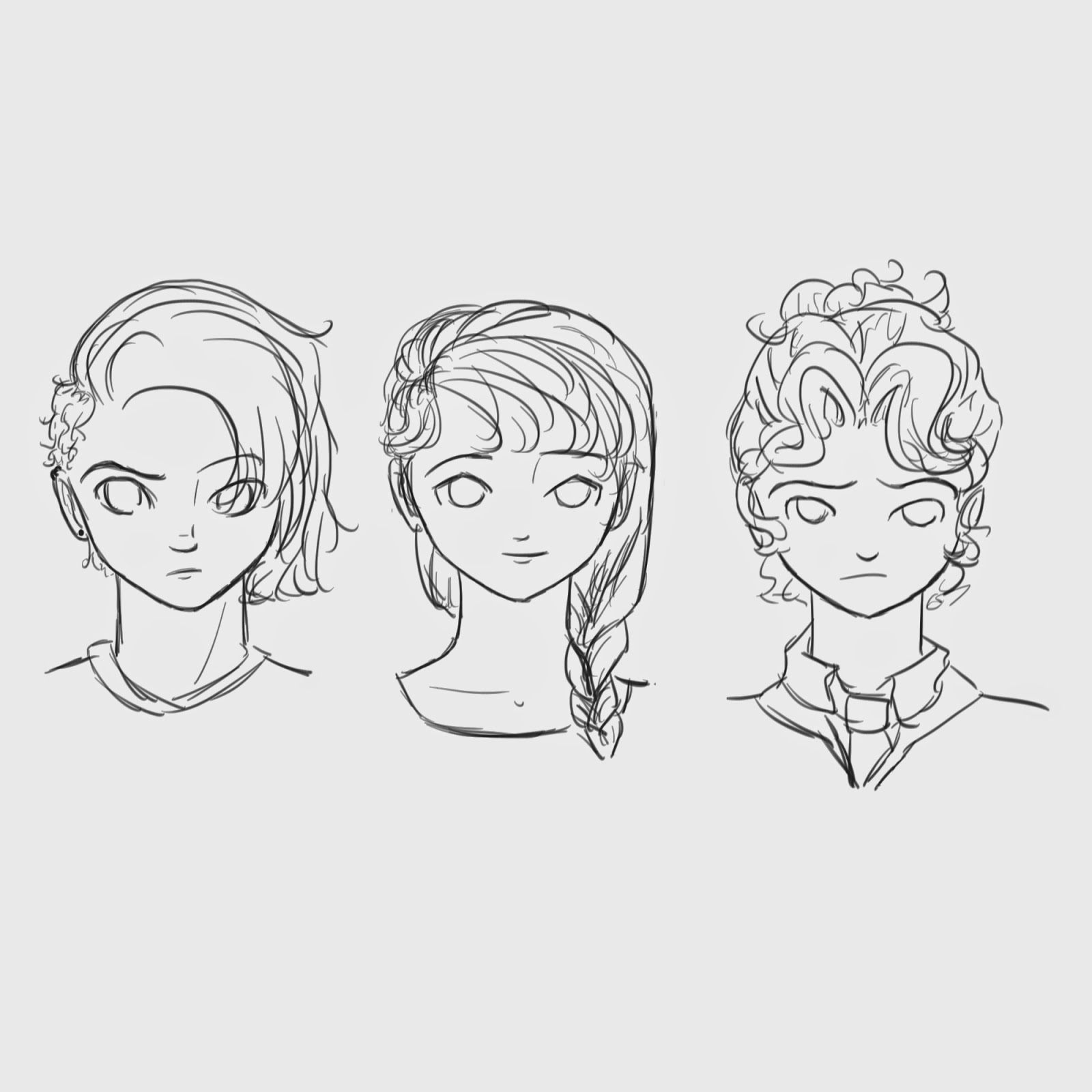 |
| Step Six - Clean up the lines and ink! |
I'm not done coloring them yet, otherwise I'd post that as well. Maybe I'll save it for a coloring tutorial sometime...
Any questions? Comments? I'd love to hear from you! And I'd also love to see your art. Post a link to your blog in the comments, or if you'd rather, email me the picture at windowtothesoulcontests[at]gmail.com. I love seeing what you guys come up with! :)
We have an art contest open for submissions, see the guidelines here.
Sunday, January 11, 2015
A Character Development Tip I Learned from Divergent
Post by Catsi Eceer, co-founder
Hello all, sorry I'm a day late. *winces* I spent the weekend at a friend's house to celebrate her birthday, and, of course, forgot to write a post beforehand.
I read Divergent by Veronica Roth last week, and watched the movie with my friend yesterday. While I must admit that I'm not unduly impressed by either, it did get me thinking. There were several very interesting aspects of the movie, and-- at least in the book--a good deal of character development. I felt that I actually knew the characters, though really, there wasn't a lot of "developing" that I could see. (Tris, to be honest, seemed rather flat for the majority of the story.)
I sat for a while and thought about it. What is it about these characters that make them feel more real than so many others in different stories?
Answer: We see their fears.
It's such a simple thing, really. What is your character afraid of? Four is afraid of four things: heights, small spaces, killing an innocent, and his father. Tris's list is a little more extensive, but to the same effect--we see what she's afraid of, and we see her.
After I'd finished ranting to my friend about how terribly the movie had ruined several of the characters, I pulled out a piece of paper and started making a few lists. (Because I love lists. I really do.) I grabbed a few of my nearest characters, and wrote down all of their fears.
(And I'm proud to say that one of them only has three fears. Take that, Four.)
Here's an exercise for all of you: Open up a Word document, or find a notebook and a pencil. Write your character's name at the top of the page, and then list everything they're afraid of. Every last thing. If you feel like going deeper, try to figure out why they're afraid of those things.
Was that hard? For an undeveloped character, it probably was. Even for a character you thought was developed before, it might have been a very difficult exercise. Fears are harder for us to give our characters. We might give them one or two random fears, like fear of spiders or claustrophobia, or maybe a deeper fear for those particularly messed up ones--fear of their abusive parent, or of being forced to hurt someone they love.
But you know what? Everyone's afraid of something.
Most everyone is afraid of several somethings, actually. I, for one, am afraid of scorpions, swimming in places I can't see the bottom of, heights, small spaces, being trapped, calling adults on the phone (yes, go ahead and laugh; I'm used to it), and losing one of my family members.
Does your character seem more real now that you know their fears? They should. Humans are fearful creatures; seeing someone with weaknesses similar to our own helps us bond with characters far faster than with a character who seems perfect.
So take your list, and figure out how to show those fears in your writing. Make your character fear, and make them human.
What are some of your character's fears? How do you show those fears in your writing?
Hello all, sorry I'm a day late. *winces* I spent the weekend at a friend's house to celebrate her birthday, and, of course, forgot to write a post beforehand.
I read Divergent by Veronica Roth last week, and watched the movie with my friend yesterday. While I must admit that I'm not unduly impressed by either, it did get me thinking. There were several very interesting aspects of the movie, and-- at least in the book--a good deal of character development. I felt that I actually knew the characters, though really, there wasn't a lot of "developing" that I could see. (Tris, to be honest, seemed rather flat for the majority of the story.)
I sat for a while and thought about it. What is it about these characters that make them feel more real than so many others in different stories?
Answer: We see their fears.
It's such a simple thing, really. What is your character afraid of? Four is afraid of four things: heights, small spaces, killing an innocent, and his father. Tris's list is a little more extensive, but to the same effect--we see what she's afraid of, and we see her.
After I'd finished ranting to my friend about how terribly the movie had ruined several of the characters, I pulled out a piece of paper and started making a few lists. (Because I love lists. I really do.) I grabbed a few of my nearest characters, and wrote down all of their fears.
(And I'm proud to say that one of them only has three fears. Take that, Four.)
Here's an exercise for all of you: Open up a Word document, or find a notebook and a pencil. Write your character's name at the top of the page, and then list everything they're afraid of. Every last thing. If you feel like going deeper, try to figure out why they're afraid of those things.
Was that hard? For an undeveloped character, it probably was. Even for a character you thought was developed before, it might have been a very difficult exercise. Fears are harder for us to give our characters. We might give them one or two random fears, like fear of spiders or claustrophobia, or maybe a deeper fear for those particularly messed up ones--fear of their abusive parent, or of being forced to hurt someone they love.
But you know what? Everyone's afraid of something.
Most everyone is afraid of several somethings, actually. I, for one, am afraid of scorpions, swimming in places I can't see the bottom of, heights, small spaces, being trapped, calling adults on the phone (yes, go ahead and laugh; I'm used to it), and losing one of my family members.
Does your character seem more real now that you know their fears? They should. Humans are fearful creatures; seeing someone with weaknesses similar to our own helps us bond with characters far faster than with a character who seems perfect.
So take your list, and figure out how to show those fears in your writing. Make your character fear, and make them human.
What are some of your character's fears? How do you show those fears in your writing?
Saturday, December 20, 2014
A Lesson on Relatablity from POKéMON
Post by Elisabeth TenBrink Kelley, co-founder
I'm a POKéMON nerd. You can tell this from the fact that I capitalize the o, k, m, o, and n, plus that I use "é" instead of "e". But another way you can tell is that I started watching the original Pokémon episodes, and the fact that I know that Jesse was extremely poor, hated Princess Day because she never had dolls, and loves "snowgasborde", that James was rich, collected bottle caps, and owned his own swimming pool, and that Meowth learned to talk and stand like a human in order to impress a female Meowth named Meowthy.
What does Team Rocket have to do with writing? Well, despite Pikachu being one of the most adorable POKéMON, I always liked Jesse, James, and Meowth more. Why?
They fight like cats and dogs, but they love each other. James throws away his favorite bottle cap to help Meowth, despite nearly breaking to tears when they took it from him earlier in the episode. James, Meowth, and the other POKéMON dress up as human dolls when Jesse fails the contest that would give her the dolls that she never had on Princess Day. Jesse panics when James and Meowth fall asleep in the snow, because she knows they could freeze. They all try to comfort Arbok and Weezing when they don't make the cut to star in a movie.
In contrast, the only hero with an even vaguely sad backstory is Brock, who's dad left, but then comes back. (It never says what happened to Ash's dad.) And Ash rarely fails. Granted, of course, he is loyal, and we do like him, but Team Rocket still manages to evoke a surprising amount of sympathy for being the people trying to steal Pikachu.
So, if kidnappers can be that likable, using these techniques, what do you think you can do with good guys? Probably one of the hardest things for writers to do, is make their heroes fail. They're the hero! They should be capable! But if they never fail, we won't care. Of course they'll win, when do they not? Don't be afraid of making your hero fail. There is nothing we identify with better than failure. That, if nothing else, is something every human is familiar with.
Elisabeth TenBrink Kelley is an aspiring author and poet. To learn more about her, see our About Us page. You can follow her on Twitter here: @ElisabethGTK.
I'm a POKéMON nerd. You can tell this from the fact that I capitalize the o, k, m, o, and n, plus that I use "é" instead of "e". But another way you can tell is that I started watching the original Pokémon episodes, and the fact that I know that Jesse was extremely poor, hated Princess Day because she never had dolls, and loves "snowgasborde", that James was rich, collected bottle caps, and owned his own swimming pool, and that Meowth learned to talk and stand like a human in order to impress a female Meowth named Meowthy.
What does Team Rocket have to do with writing? Well, despite Pikachu being one of the most adorable POKéMON, I always liked Jesse, James, and Meowth more. Why?
- They fail
- They have sad back stories
- Though they are the bad guys, they are loyal
They fight like cats and dogs, but they love each other. James throws away his favorite bottle cap to help Meowth, despite nearly breaking to tears when they took it from him earlier in the episode. James, Meowth, and the other POKéMON dress up as human dolls when Jesse fails the contest that would give her the dolls that she never had on Princess Day. Jesse panics when James and Meowth fall asleep in the snow, because she knows they could freeze. They all try to comfort Arbok and Weezing when they don't make the cut to star in a movie.
In contrast, the only hero with an even vaguely sad backstory is Brock, who's dad left, but then comes back. (It never says what happened to Ash's dad.) And Ash rarely fails. Granted, of course, he is loyal, and we do like him, but Team Rocket still manages to evoke a surprising amount of sympathy for being the people trying to steal Pikachu.
So, if kidnappers can be that likable, using these techniques, what do you think you can do with good guys? Probably one of the hardest things for writers to do, is make their heroes fail. They're the hero! They should be capable! But if they never fail, we won't care. Of course they'll win, when do they not? Don't be afraid of making your hero fail. There is nothing we identify with better than failure. That, if nothing else, is something every human is familiar with.
Elisabeth TenBrink Kelley is an aspiring author and poet. To learn more about her, see our About Us page. You can follow her on Twitter here: @ElisabethGTK.
Monday, December 1, 2014
Sacrifice Short Story Contest
This contest is closed.
A new month and a new contest. This contest is sponsored by Leah Good, the winner of the poetry category of our last contest, and author of Counted Worthy. Thus, this will be our first contest with a prize: a free ebook copy of Counted Worthy.
So, we've got to have a theme, right? Well, our theme will be "sacrifice". You must portray it in some way in your story. I can't wait to see what you submit, so here are the rules:
Include "Sacrifice Contest" in the subject line.
Your name or pen name should be in the body of the email ONLY, but be sure to include it.
Attach as a doc., docx., or txt., or in the body of the email.
Keep the content PG-13 or cleaner.
You must own the rights to the submitted piece and be the creator (or translator).
Previous and simultaneous submissions are welcome.
All rights remain with the creator, though we ask to post your story on this blog and the newsletter. If you would rather that your story not appear here, let us know in the email. This will not affect your chances of winning.
You may include a short bio, as well as link to your blog and/or social media.
Send your submission or any questions to windowtothesoulcontests@gmail.com
We look forward to seeing your work!
Another contest currently open is for poetry with a holiday theme, you can find the rules here.
A new month and a new contest. This contest is sponsored by Leah Good, the winner of the poetry category of our last contest, and author of Counted Worthy. Thus, this will be our first contest with a prize: a free ebook copy of Counted Worthy.
So, we've got to have a theme, right? Well, our theme will be "sacrifice". You must portray it in some way in your story. I can't wait to see what you submit, so here are the rules:
Include "Sacrifice Contest" in the subject line.
Your name or pen name should be in the body of the email ONLY, but be sure to include it.
Attach as a doc., docx., or txt., or in the body of the email.
Keep the content PG-13 or cleaner.
You must own the rights to the submitted piece and be the creator (or translator).
Previous and simultaneous submissions are welcome.
All rights remain with the creator, though we ask to post your story on this blog and the newsletter. If you would rather that your story not appear here, let us know in the email. This will not affect your chances of winning.
You may include a short bio, as well as link to your blog and/or social media.
Send your submission or any questions to windowtothesoulcontests@gmail.com
We look forward to seeing your work!
Another contest currently open is for poetry with a holiday theme, you can find the rules here.
Saturday, November 29, 2014
7 Things to Do Before You Give Up on Your Novel
Post by Catsi Eceer, co-founder
I bet we've all been there at some point--your novel is just too boring/cliche/unbelievable/plotless/whatever that you feel there's no point in writing it any more.
You loved this story at some point. It was a shiny plot bunny then, and you could just picture it on the shelf at the bookstore.
But now it's lost all its charm, and you dread opening up the document. In fact, most days, you don't open it up at all.
What do you do? Do you give up on the story, and start something new? Do you take a break? Do you force yourself to keep writing, even though you hate it?
I think the answer is different for each writer. Sometimes you're really just burnt out writing-wise, and taking a few days off will clear up any problems. Or maybe you've taken off for too long, and you're having trouble getting back into the routine.
But sometimes, the answer might really be that the story just isn't worth continuing.
Now, before you enthusiastically pump my hand and thank me for giving you permission to ditch your story, there's a few qualifiers. You need to get through the list I have below, and you need to think each item through before moving on.

If you've gotten this far, and nothing is getting your interest back in your story, maybe it is time to start something new. Something you're truly passionate about, and something you'll see all the way through to completion.
Just make sure you won't burn out halfway through again. Develop, develop, develop. Make sure this is a story you truly love. Make it something you'd want to read, and read again. Daydream about seeing it on a bookshelf, on Amazon.com, on a random review blog, read by somebody you've never met and probably will never meet. Imagine what the cover will look like, and the movie that will be made from it.
Go ahead and dream. That's how we write, isn't it?
Catsi Eceer is an aspiring author of fantasy and dystopian novels. To learn more about her, visit our "About Us" page.
We have currently have a holiday poetry contest open, which you can find here.
I bet we've all been there at some point--your novel is just too boring/cliche/unbelievable/plotless/whatever that you feel there's no point in writing it any more.
You loved this story at some point. It was a shiny plot bunny then, and you could just picture it on the shelf at the bookstore.
But now it's lost all its charm, and you dread opening up the document. In fact, most days, you don't open it up at all.
What do you do? Do you give up on the story, and start something new? Do you take a break? Do you force yourself to keep writing, even though you hate it?
I think the answer is different for each writer. Sometimes you're really just burnt out writing-wise, and taking a few days off will clear up any problems. Or maybe you've taken off for too long, and you're having trouble getting back into the routine.
But sometimes, the answer might really be that the story just isn't worth continuing.
Now, before you enthusiastically pump my hand and thank me for giving you permission to ditch your story, there's a few qualifiers. You need to get through the list I have below, and you need to think each item through before moving on.

- Are you really sure your story is boring? Or is there just another "better" story that you want to write?
I won't pretend that I've never had this happen to me. Plenty of times, I'll be about halfway through a rough draft, when I'll get a new story idea--one I'm sure is far better than this story will ever be.
Sometimes, that really is the case. If you started this story spur of the moment, maybe there's just not a lot of good plot to keep the story going. It might really be best to drop this story and work on something else. But be careful--if you start writing that new story idea right away, what's going to keep it from doing the same thing halfway through?
Just make sure to identify the difference between a good story idea, and a "shiny plot bunny." Plot bunnies are not reliable, shiny or otherwise. Develop, develop, develop, until you've gotten down to the core of the story. If it's still worth writing, go for it. - Have you taken a break from the story?
Try taking a break, if you're stuck. Spend the day with your family, or go somewhere with your friends. Watch a movie. Go for a walk. Do something away from your computer, laptop, or notebook.
If you're just stuck on a story problem that needs to be solved before you can keep going--a very crippling issue; I know this from experience--chances are, just ignoring it for a few days will actually help. Your subconscious will be at work solving the problem while you get a break from your story. - Have you gone back to writing after the break?
I'm serious. After you're done with your break, sit down and write. Don't just say, "Okay, I've gone for three days without writing this story and I still don't feel like writing it. Goodbye, story!" Of course you're not going to want to write. Imaginations are lazy. When you go for an extended period of time without using it, it's going to be tricky getting back into the swing of writing.
Do it anyway. After your break, spend a few more days writing. If you're still having problems with your writing after a week, maybe it is time to think about moving on. - Identify what your story is really about. Are you still writing that?
I've had this happen to me very often. I get so caught up in the words, the actions, the scenes, that I forget what the story is about. I have to take a step back, take a deep breath, and remember what I'm writing.
What is your story goal? What does your main character want? What about that unnamable feeling you get when you think about your climax? Are you still writing that? - Is it really a bad story, or do you just have Chapter Seven Syndrome?
Chapter Seven Syndrome is my word for "I'm about two-thirds of the way through the story and I'm very sure that this is the worst thing I've ever written." It's not usually at chapter seven for most people, but when I started writing using a twelve-chapter outline, chapter seven was always where I lost my enthusiasm.
If this is where you're at, take heart--it's a passing phase. Take a day off today, and start writing again tomorrow. Write as much as you can, even if it's awful. Eventually you'll get to a scene you've been wanting to write, and hopefully you'll start enjoying it again. - Remember the enthusiasm you had for this story when you started. Is there any of that passion still left inside of you?
I've found that writing a little note of encouragement to your future self when you start writing a story is very helpful. Take all of your enthusiasm and passion and love for your story, and write a few paragraphs about how amazing this story is. Go ahead and make it all flattery. Just make it sincere. If you have a good writer friend, ask them to write a little bit of something too. Then hide it all away somewhere, and don't look at it again until you're completely stuck and hating the story.
Can you blow on that ember and relight the fire you had for this story? - Are you really willing to give up?
It sounds kind of harsh when I say it like that, but it's the truth. By giving up on your novel, you're doing just that--giving up. Are you ready to admit defeat?
If you've gotten this far, and nothing is getting your interest back in your story, maybe it is time to start something new. Something you're truly passionate about, and something you'll see all the way through to completion.
Just make sure you won't burn out halfway through again. Develop, develop, develop. Make sure this is a story you truly love. Make it something you'd want to read, and read again. Daydream about seeing it on a bookshelf, on Amazon.com, on a random review blog, read by somebody you've never met and probably will never meet. Imagine what the cover will look like, and the movie that will be made from it.
Go ahead and dream. That's how we write, isn't it?
Catsi Eceer is an aspiring author of fantasy and dystopian novels. To learn more about her, visit our "About Us" page.
We have currently have a holiday poetry contest open, which you can find here.
Saturday, October 18, 2014
Outlining for NaNoWriMo
Post by Catsi Eceer, co-founder
Hey, everyone! Catsi here, back (finally!) from the hiatus. So excited to get into posting again!
I'm also pretty excited for the event coming up in a few weeks, to be specific, on November 1. If you don't know what I'm talking about, I'll give you a hint: It's the time of year that most writers either love or hate, or a combination of the two.
Give up?
(Come on, this should be easy. The answer is also in the title of this blog post.)
NaNoWriMo is the abbreviation for National Novel Writing Month. It's an organization that challenges you to write 50,000 words (a novel) in one month (November). Sound insane? Yeah, that's pretty much how we writers are.
This will be my first year doing it, so as always, I've been researching a ton. What I've found is that since I'm such a structured, planning writer, I should definitely spend as much of October as I can spare outlining. If you want to do NaNo the traditional way, you don't outline a speck and just start writing on November first. Knowing me, I'd be excited for the first few days and then burn out by the end of the week and trash the novel. So I'm outlining.
Now, I don't want to outline too extensively. That's also a recipe for burn-out. I'll spend all of my enthusiasm sketching chapters and developing motives, and then won't ever start writing. (Not a great way to get a book published, trust me. No one wants to read an outline.)
So I have to do it somewhere in the middle. Where exactly in the middle varies from novel to novel, writer to writer. I still haven't pinned down exactly what works for me. Everyone outlines differently, so I do my best to try several different outlining methods, and then keep what works and toss what doesn't.
With my last novel, I wrote out the "boring facts," and then wrote a step-outline--a list of scenes in the order I thought they would go in the novel. (They weren't all at the right place, but the good thing about using Microsoft Word is that you can just move things around to adjust your outline. Or you can just ignore your outline completely while writing. I think I have a little bit of OCD, so I have to keep my outline accurate the whole way through the rough draft.)
This is what I've found works best for me, and what I'm doing to outline my fourth novel. It isn't going to work for everyone--chances are, it'll only work for me--but maybe it will give you some ideas to try out.
Step one: Find a piece of paper and sharpened pencil. (Harder than you would think.)
The Boring Facts
Characterization
Plot
Setting
Style
Theme
If you've ever taken a literature class, chances are you've heard these five words before. They're the "Elements of a Story," and my literature textbook loved to make sure I knew them. (And here I am, three years later, and I still know them by heart.) Dry and uninspiring as they may be, they're still important, and they can be useful during the outlining process.
Characterization
Characters are one of the most important parts of every story. The reason should be pretty obvious--A story has to be about someone. If it's just a bunch of events, we won't feel any sort of emotional connection. There won't be someone for us to care about, to root, cheer, and cry for.
Take the time to develop your characters. Give them all a goal, a reason to be in the story. Something they want, something they want to stop, someone they care about. A backstory, some family and friends, and a good antagonist. (Spend plenty of time on the antagonist--he's important.)
Plot
Here's the second most important story element. (Or, at least, for a character-driven writer it's second important. If you write plot-first, you probably think differently.) Your characters need to do something besides sit around and look pretty.
One of my favorite ways to figure out the plot of a story is to ask "What does my main character want?" and then follow that up with "What can stop them from getting that?" Explore any plot threads that come up until you have a main goal, a villain, and maybe some subplots too.
Setting
Where and when is your story set? It can't be floating out in nothingness. (Or can it?)
I read somewhere that if you can pick up your whole novel and drop it somewhere else without affecting the story, you haven't found the right setting yet. Make the location an important part of the story, and maybe it can tie into the characters too. If your character is terrified of water, maybe it's on a ship. Or if they're claustrophobic, caves would be an interesting place to put it.
Style
The exact definition of this is a little different than how I use it when I'm outlining. (Creative license, okay?) By this, I mean the obvious details: Past or present tense, first, third, or even second person, the genre, target audience, and whatever else you feel like writing down.
The actual writing style, or your voice, isn't something that can be easily noted down. Some people have a very informal, laid-back writing style. Some have a wordy, where-is-my-dictionary-because-I-have-no-idea-what-this-word-means style. It all depends on the author.
Theme
What is the moral of your story? What does it mean?
I don't recommend spending a ton of time on this, especially if you're a beginning writer. Preaching a moral through a story is very difficult to avoid when you have a specific theme in mind. I've always found it best for me to just write the story, being true to the characters, and see what theme comes out. Then during rewrites I work it in more. (Although during this story, I have a far more specific idea for a theme than I've ever had for one before... We'll see how it goes.)
Once I've gotten everything figured out, I write a quick synopsis for the story, like one that you'd find on the back cover. It tends to get me excited about the project, because I can picture it as a published book.
The Outline
Now I start figuring out exactly how the story will go. Usually, I have a few ideas for scenes in my head already at this point, but I still need to brainstorm more and put them all in order.
Five Important Scenes:
The Inciting Incident (The day everything changed)
The Choice (Accepting the call of the story goal)
Plot Twist (A surprise halfway through the story)
The Black Moment (Everything that could possibly go wrong goes wrong.)
Climax (The final clash between hero and villain)
After I've figured out those scenes, I'll start filling in between them as best as I can. This gives me a list of "scene summaries," each scene summarized in one or two sentences. I can move scenes around, add more, and take some out at will. This also helps me see where any plot holes may arise, and do my best to fix them before they become a problem.
Once I'm happy with the way the story goes, I'm ready to write!
How do you outline? Are you doing NaNoWriMo this year? Let me know in the comments!
To learn more about Catsi, visit our "About Us" page.
We have a contest open for art, poetry, and prose, all together! Come see details here.
Hey, everyone! Catsi here, back (finally!) from the hiatus. So excited to get into posting again!
I'm also pretty excited for the event coming up in a few weeks, to be specific, on November 1. If you don't know what I'm talking about, I'll give you a hint: It's the time of year that most writers either love or hate, or a combination of the two.
Give up?
(Come on, this should be easy. The answer is also in the title of this blog post.)
NaNoWriMo is the abbreviation for National Novel Writing Month. It's an organization that challenges you to write 50,000 words (a novel) in one month (November). Sound insane? Yeah, that's pretty much how we writers are.
This will be my first year doing it, so as always, I've been researching a ton. What I've found is that since I'm such a structured, planning writer, I should definitely spend as much of October as I can spare outlining. If you want to do NaNo the traditional way, you don't outline a speck and just start writing on November first. Knowing me, I'd be excited for the first few days and then burn out by the end of the week and trash the novel. So I'm outlining.
Now, I don't want to outline too extensively. That's also a recipe for burn-out. I'll spend all of my enthusiasm sketching chapters and developing motives, and then won't ever start writing. (Not a great way to get a book published, trust me. No one wants to read an outline.)
So I have to do it somewhere in the middle. Where exactly in the middle varies from novel to novel, writer to writer. I still haven't pinned down exactly what works for me. Everyone outlines differently, so I do my best to try several different outlining methods, and then keep what works and toss what doesn't.
With my last novel, I wrote out the "boring facts," and then wrote a step-outline--a list of scenes in the order I thought they would go in the novel. (They weren't all at the right place, but the good thing about using Microsoft Word is that you can just move things around to adjust your outline. Or you can just ignore your outline completely while writing. I think I have a little bit of OCD, so I have to keep my outline accurate the whole way through the rough draft.)
This is what I've found works best for me, and what I'm doing to outline my fourth novel. It isn't going to work for everyone--chances are, it'll only work for me--but maybe it will give you some ideas to try out.
Step one: Find a piece of paper and sharpened pencil. (Harder than you would think.)
The Boring Facts
Characterization
Plot
Setting
Style
Theme
If you've ever taken a literature class, chances are you've heard these five words before. They're the "Elements of a Story," and my literature textbook loved to make sure I knew them. (And here I am, three years later, and I still know them by heart.) Dry and uninspiring as they may be, they're still important, and they can be useful during the outlining process.
Characterization
Characters are one of the most important parts of every story. The reason should be pretty obvious--A story has to be about someone. If it's just a bunch of events, we won't feel any sort of emotional connection. There won't be someone for us to care about, to root, cheer, and cry for.
Take the time to develop your characters. Give them all a goal, a reason to be in the story. Something they want, something they want to stop, someone they care about. A backstory, some family and friends, and a good antagonist. (Spend plenty of time on the antagonist--he's important.)
Plot
Here's the second most important story element. (Or, at least, for a character-driven writer it's second important. If you write plot-first, you probably think differently.) Your characters need to do something besides sit around and look pretty.
One of my favorite ways to figure out the plot of a story is to ask "What does my main character want?" and then follow that up with "What can stop them from getting that?" Explore any plot threads that come up until you have a main goal, a villain, and maybe some subplots too.
Setting
Where and when is your story set? It can't be floating out in nothingness. (Or can it?)
I read somewhere that if you can pick up your whole novel and drop it somewhere else without affecting the story, you haven't found the right setting yet. Make the location an important part of the story, and maybe it can tie into the characters too. If your character is terrified of water, maybe it's on a ship. Or if they're claustrophobic, caves would be an interesting place to put it.
Style
The exact definition of this is a little different than how I use it when I'm outlining. (Creative license, okay?) By this, I mean the obvious details: Past or present tense, first, third, or even second person, the genre, target audience, and whatever else you feel like writing down.
The actual writing style, or your voice, isn't something that can be easily noted down. Some people have a very informal, laid-back writing style. Some have a wordy, where-is-my-dictionary-because-I-have-no-idea-what-this-word-means style. It all depends on the author.
Theme
What is the moral of your story? What does it mean?
I don't recommend spending a ton of time on this, especially if you're a beginning writer. Preaching a moral through a story is very difficult to avoid when you have a specific theme in mind. I've always found it best for me to just write the story, being true to the characters, and see what theme comes out. Then during rewrites I work it in more. (Although during this story, I have a far more specific idea for a theme than I've ever had for one before... We'll see how it goes.)
Once I've gotten everything figured out, I write a quick synopsis for the story, like one that you'd find on the back cover. It tends to get me excited about the project, because I can picture it as a published book.
The Outline
Now I start figuring out exactly how the story will go. Usually, I have a few ideas for scenes in my head already at this point, but I still need to brainstorm more and put them all in order.
Five Important Scenes:
The Inciting Incident (The day everything changed)
The Choice (Accepting the call of the story goal)
Plot Twist (A surprise halfway through the story)
The Black Moment (Everything that could possibly go wrong goes wrong.)
Climax (The final clash between hero and villain)
After I've figured out those scenes, I'll start filling in between them as best as I can. This gives me a list of "scene summaries," each scene summarized in one or two sentences. I can move scenes around, add more, and take some out at will. This also helps me see where any plot holes may arise, and do my best to fix them before they become a problem.
Once I'm happy with the way the story goes, I'm ready to write!
How do you outline? Are you doing NaNoWriMo this year? Let me know in the comments!
To learn more about Catsi, visit our "About Us" page.
We have a contest open for art, poetry, and prose, all together! Come see details here.
Saturday, April 26, 2014
Rules and Kites
Post by Elisabeth TenBrink Kelley, co-founder
 I very recently moved from Mexico to the state of Washington. Being who I am, I hated it. I hate change, it's simply who I am. But, with the change came new things, new experiences, and the new experiences brought new views, understanding, and inspiration. This week I went kite flying with my grandma, and I realized how writing is very much like flying, and then I realized that all the arts are like it. Heck, maybe every skill is.
When flying a kite, you have to wait for a good wind. You can, of course, run to make your own wind, but once you run out of room to run, your kite will fall down again. Running can make a poor winds enough to get up to the higher winds, but in and of itself is not enough. To me, the wind represents luck. But to fly a kite well, you need to understand when to let out string, and when not to. If you let out too much string, your kite will fall, but if you don't let out any, it will stay close to the ground, subject to the fickle near-ground winds that constantly die, pick up, and die again.
Your hand, your holding of the string, is rules. All the different writing/drawing/painting/poetry rules that exist are represented by your hand. When you hold it down, the kite catches the wind and soars higher. Once it has enough height, you let out more string, the equivalent of trying some things that aren't in the rulebook, and your potential increases. As you get higher (more skilled), you can let out more string (ignore the rules more).
The greatest writers ignore the rules, because the important things are natural, and the things that can be bent or broken, they can have the skill to do without. Everyone needs to follow the rules at the beginning, to learn, and as they progress, they can do their own thing more. They are at the point where they would fly highest if they just let go of the kite and let it soar on its own. Of course, in real life we never do that because we like to keep our kites.
I am an amateur artist when it comes to drawing. I make some pretty good stick figures, and a single, unpaired eye (I can never make them match) but that's really all. Remember when Josie posted that awesome art tutorial? It made me feel empowered, like I could finally draw something well, but instead I left the instructions and ended up failing, because I'm not at that point in my drawing skills. My kite is crashing into the trees because I give it too much string.
What about you? Are you giving yourself too much string? Too little?
Elisabeth TenBrink Kelley is an aspiring author and poet. To learn more about her, see our About Us page. You can follow her on Twitter here: @ElisabethGTK.
We have a synopsis contest currently open, which you can find here. Our haiku contest is past the deadline, and we will announce the winner on the first of May both here and in our newsletter, which you can sign up to here.
I very recently moved from Mexico to the state of Washington. Being who I am, I hated it. I hate change, it's simply who I am. But, with the change came new things, new experiences, and the new experiences brought new views, understanding, and inspiration. This week I went kite flying with my grandma, and I realized how writing is very much like flying, and then I realized that all the arts are like it. Heck, maybe every skill is.When flying a kite, you have to wait for a good wind. You can, of course, run to make your own wind, but once you run out of room to run, your kite will fall down again. Running can make a poor winds enough to get up to the higher winds, but in and of itself is not enough. To me, the wind represents luck. But to fly a kite well, you need to understand when to let out string, and when not to. If you let out too much string, your kite will fall, but if you don't let out any, it will stay close to the ground, subject to the fickle near-ground winds that constantly die, pick up, and die again.
Your hand, your holding of the string, is rules. All the different writing/drawing/painting/poetry rules that exist are represented by your hand. When you hold it down, the kite catches the wind and soars higher. Once it has enough height, you let out more string, the equivalent of trying some things that aren't in the rulebook, and your potential increases. As you get higher (more skilled), you can let out more string (ignore the rules more).
The greatest writers ignore the rules, because the important things are natural, and the things that can be bent or broken, they can have the skill to do without. Everyone needs to follow the rules at the beginning, to learn, and as they progress, they can do their own thing more. They are at the point where they would fly highest if they just let go of the kite and let it soar on its own. Of course, in real life we never do that because we like to keep our kites.
I am an amateur artist when it comes to drawing. I make some pretty good stick figures, and a single, unpaired eye (I can never make them match) but that's really all. Remember when Josie posted that awesome art tutorial? It made me feel empowered, like I could finally draw something well, but instead I left the instructions and ended up failing, because I'm not at that point in my drawing skills. My kite is crashing into the trees because I give it too much string.
What about you? Are you giving yourself too much string? Too little?
Elisabeth TenBrink Kelley is an aspiring author and poet. To learn more about her, see our About Us page. You can follow her on Twitter here: @ElisabethGTK.
We have a synopsis contest currently open, which you can find here. Our haiku contest is past the deadline, and we will announce the winner on the first of May both here and in our newsletter, which you can sign up to here.
Saturday, February 8, 2014
Dialogue, part one
Post by Catsi Eceer, co-founder
Dialogue is a funny thing. If you get it right, your writing flows better and is more realistic. If you get it wrong, all of your characters will seem stiff and about as real as a flannel graph.
So what makes good dialogue? And, more importantly, how do you write it?
The first thing about realistic dialogue is that it needs to be realistic. (Bet you didn't see that one coming!) Different people talk differently. Your characters should too.
We'll take a look at a few of the characters from my novel, Worlds Apart. (I'm working on editing it right now, so hopefully this will help me with their dialogue as well as you with your characters.)
First of all, there's my main character, Bree. Jonaver is from Mreda, another world that Bree is transported to. (Think Middle Earth.) Then we have Quarl, a random guard who is awesome fun. And last but not least, Kauvin, the villain.
They all speak differently. Bree is your typical teenage girl, so it's fairly easy to tell that she's talking--she's the only one who says, "Yeah," and "Whatever."
Jonaver, since he's from Mreda, talks a bit different from Bree. He mixes Mredaic words in with English, and sounds slightly more formal than Bree.
Quarl is one of two guards in a scene from the beginning of the story. I needed a way to tell them apart, since Bree doesn't know their names, and "first guard" and "second guard" were starting to get old. So, the answer was to give one of them an accent.
Kauvin is Mredan, like Jonaver, but more refined. He doesn't use contractions, which makes him sound very stuck-up. He's also a good speaker, so his words need to be smooth and convincing.
Now you can probably figure out who of the above characters are talking in each of these dialogue snatches:
Aside from the line where Bree copies Quarl's accent, it's fairly obvious who's talking. Even if they don't have an obvious accent or dialect, even just their personality can come through their dialogue:
Bree: Well, that worked. On to plan B.
Lana: We have a plan B?
Bree: Nope. But we're going to make one up.
Sometimes a character will have a favorite word or phrase that they use whenever given half the chance. Bree will say "Go away" when someone is bugging her. She doesn't really mean it, it's just her version of "Shut up."
You have to be careful with this, though. If they use a certain word too much, it will start to get on your reader's nerves.
Now, before I go, I've got an exercise for you. Gather up your characters, and start asking them the names for several different things. (Eg, a purse, Coke, the bathroom, etc.) Different characters will call them different things.
Me: *drops handbag on table* What is this?
Bree: *boredly* A purse.
Jonaver: A bag.
Aster: *grabs handbag* *tears it open* What? It's empty!
Me: *sets bottle of Coke on table* How about this?
Bree: *tries to get knife to balance on tip* Soda.
Jonaver: ...I have no idea.
Aster: Can I drink it?
Me: What would you say if you were surprised?
Bree: Do you really need to use us for examples?
Me: ..That is not what you would say.
Bree: ... *pushes back chair* *stomps out of room*
Jonaver: *watches her leave*
Me: You two still haven't answered me.
Jonaver: What?!
Me: I said, you two still haven't-
Jonaver: No, that's what I'd say if I were surprised.
Me: Oh. And you, Aster?
Aster: Interesting.
Me: Try again.
Aster: Wonder where Bree went... *walks out after Bree*
(Well, now you all know about the legendary cooperation of my characters.)
So how about you? What are some ways you use dialogue to show your characters as individual people?
To learn more about Catsi, see the About Us page.
Dialogue is a funny thing. If you get it right, your writing flows better and is more realistic. If you get it wrong, all of your characters will seem stiff and about as real as a flannel graph.
So what makes good dialogue? And, more importantly, how do you write it?
The first thing about realistic dialogue is that it needs to be realistic. (Bet you didn't see that one coming!) Different people talk differently. Your characters should too.
We'll take a look at a few of the characters from my novel, Worlds Apart. (I'm working on editing it right now, so hopefully this will help me with their dialogue as well as you with your characters.)
First of all, there's my main character, Bree. Jonaver is from Mreda, another world that Bree is transported to. (Think Middle Earth.) Then we have Quarl, a random guard who is awesome fun. And last but not least, Kauvin, the villain.
They all speak differently. Bree is your typical teenage girl, so it's fairly easy to tell that she's talking--she's the only one who says, "Yeah," and "Whatever."
Jonaver, since he's from Mreda, talks a bit different from Bree. He mixes Mredaic words in with English, and sounds slightly more formal than Bree.
Quarl is one of two guards in a scene from the beginning of the story. I needed a way to tell them apart, since Bree doesn't know their names, and "first guard" and "second guard" were starting to get old. So, the answer was to give one of them an accent.
Kauvin is Mredan, like Jonaver, but more refined. He doesn't use contractions, which makes him sound very stuck-up. He's also a good speaker, so his words need to be smooth and convincing.
Now you can probably figure out who of the above characters are talking in each of these dialogue snatches:
"Hope you two know where you're going, 'cause I'll be lost in, like, thirty seconds." (Bree)
"Oi! It's the queen!" (Quarl)
"Oi! No, it ain't!" (Bree being snarky)
"Welcome to Arwole, Bree." (Jonaver)
"It cannot be McKinley. Surely you meant something else." (Kauvin)
Aside from the line where Bree copies Quarl's accent, it's fairly obvious who's talking. Even if they don't have an obvious accent or dialect, even just their personality can come through their dialogue:
Bree: Well, that worked. On to plan B.
Lana: We have a plan B?
Bree: Nope. But we're going to make one up.
Sometimes a character will have a favorite word or phrase that they use whenever given half the chance. Bree will say "Go away" when someone is bugging her. She doesn't really mean it, it's just her version of "Shut up."
You have to be careful with this, though. If they use a certain word too much, it will start to get on your reader's nerves.
Now, before I go, I've got an exercise for you. Gather up your characters, and start asking them the names for several different things. (Eg, a purse, Coke, the bathroom, etc.) Different characters will call them different things.
Me: *drops handbag on table* What is this?
Bree: *boredly* A purse.
Jonaver: A bag.
Aster: *grabs handbag* *tears it open* What? It's empty!
Me: *sets bottle of Coke on table* How about this?
Bree: *tries to get knife to balance on tip* Soda.
Jonaver: ...I have no idea.
Aster: Can I drink it?
Me: What would you say if you were surprised?
Bree: Do you really need to use us for examples?
Me: ..That is not what you would say.
Bree: ... *pushes back chair* *stomps out of room*
Jonaver: *watches her leave*
Me: You two still haven't answered me.
Jonaver: What?!
Me: I said, you two still haven't-
Jonaver: No, that's what I'd say if I were surprised.
Me: Oh. And you, Aster?
Aster: Interesting.
Me: Try again.
Aster: Wonder where Bree went... *walks out after Bree*
(Well, now you all know about the legendary cooperation of my characters.)
So how about you? What are some ways you use dialogue to show your characters as individual people?
To learn more about Catsi, see the About Us page.
Subscribe to:
Posts (Atom)